!!!! Blog 4: Why wouldn’t you learn Irish? Exploring the creative possibilities of language learning
In her fourth and final blog, Dr Claire Dunne explores the creative power of the Irish language and how to enjoy it in everyday life.
Why wouldn’t you learn Irish? Exploring the creative possibilities of language learning
The Irish language is all around us and there are plenty of ways to enjoy using your Irish creatively in your daily life.
Irish All Around Me
Go out for a walk in your locality. Take notice (or a photo) of the signs that you see written in Irish. You will encounter plenty of bilingual road signs, as well as Irish-language names of schools or shops etc.
Do you hear any Irish phrases being used on the bus, on the Luas, or on the train? What do they mean? Make a list of these new phrases.
Have a look at some local place names. What do they mean? Is there a story behind the place name? Go to logainm.ie to find out more information on the place name.
You don’t have to venture outside of your own home to encounter Irish though.
There is lots of Irish all around you at home! Have a look around your home. Can you see anything that has something written in Irish on it, for example, products made in Ireland like Bainne Úr (Fresh milk) and Mil (honey).
More ideas for noticing the Irish in your environment are available on An Ghaeilge sa Bhaile / Irish at Home
My Irish-Language Community
There may be people in your family or neighbourhood who have a few words of Irish. Even if it is years since you learned Irish at school, your Irish has not disappeared! You might be surprised to find how many phrases you can still remember.
Do any of your relatives, friends or neighbours have some Irish? Do they know any other languages? Ask them what their favourite word or phrase is.
Choose a Cara Comhrá or Conversation Pal. Greet that person in Irish each day. Send them a text or message regularly. Why not send them a funny meme in Irish that you like?
Tá mé in ann… Ba mhaith liom a bheith in ann…
Have a think about what you would like to be able to do in Irish. These goals are personal to you. Would you like to listen to a song in Irish, tell a joke in Irish or send a text in Irish?
You can start small. Why not start following An Siopa Leabhar on social media and see recommendations for Irish books? Try using your Irish to write a short post underneath.
If you are interested in learning a bit more about Irish folklore, have a listen to Blúiríní Béaloidis.
Or sit back and watch a short film in Irish Irish Language Archives – IFI Archive Player. (Mean Girls as Gaeilge is a personal favourite! Watch Cailíní Gránna | Irish language Mean Girls parody – YouTube)
If you open your eyes and ears to the language you will find lots of ways to use Irish creatively in your daily life.
!!!! Blog 3: Why wouldn’t you learn Irish? Exploring the creative possibilities of language learning
In her latest blog, Dr Claire Dunne continues her series on the creative role of language.
Why wouldn’t you learn Irish? Exploring the creative possibilities of language learning
Learning Irish impacts on many dimensions of our identity and our relationships with others. The language journey doesn’t stop at the school gates but can include other important people in our lives.
Learning Irish is important for classroom relationships and wellness
The Irish lesson is a space during the week where children can speak about their own lives and experiences. Think about some of the themes that are woven into the teaching of Irish – Mo chaitheamh aimsire, Mo mhuintir. These themes create important opportunities to develop self-awareness, and to acknowledge the diverse experiences children have within and outside of school.
Learning Irish provides opportunities for parental and family involvement
When children begin formally learning Irish in primary school, parents and families also have the opportunity to engage and / or re-engage with the language. Sharing experiences of learning Irish, or another language, can support a child’s language journey. Try some of the playful activities at home that are in the resource Gaeilge sa Bhaile.
Learning Irish is important to get to know yourself and others
Speaking or using another language allows you to get to know another side of yourself. It offers the potential to develop more creative and linguistic talents. Sometimes you are less articulate or funny in an additional language compared to your mother tongue, but this is a rich and humbling experience getting to know this more vulnerable part of yourself. It can help you relate more to other additional language speakers.
Speaking Irish connects you to other generations of Irish speakers, and also helps you become part of an international community of plurilingual speakers. Learning Irish provides opportunities for creative growth and can impact positively on many dimensions of our life and development.
So why wouldn’t you learn Irish?
!!!! Blog 2: Why wouldn’t you learn Irish? Exploring the creative possibilities of language learning
Why wouldn’t you learn Irish? Exploring the creative possibilities of language learning
In her second blog post of the series, Dr Claire Dunne explores how learning an additional language has been shown to have many benefits, including the development of creative and flexible thinking, helping us make connections, as well as supporting future language learning.
Learning Irish gives us different perspectives
Insights from the Irish language can help us have a nuanced understanding of the world. Think of how feelings and emotions are described in Irish. Tá áthas orm. Tá fearg orm. In Irish you can say that a feeling comes on you and then leaves. This is an interesting perspective showing that feelings can be transient and don’t have to define us.
Oide and Buime are the original words for teacher in Irish. They are also synonyms for foster parent. The full meaning of our role as educators is encapsulated in this Irish term and serves as a reminder to care for children beyond their academic achievement.
Learning Irish is important to foster a connection with our environment
It is no surprise that the places in the world with the largest degree of biodiversity also have the largest range of languages spoken, e.g. Papua New Guinea. Living sustainably is linked to a respect for diversity in both our physical and social environment.
Proverbs and idioms in Irish have an enduring importance. As we see in the examples below, they often relate to the landscape and help us to explore how our ancestors came to understand and live in harmony with their environments, and how we can draw on that wisdom today.
Éist le fuaim na habhann agus gheobhaidh tú breac.
An té nach gcuirfidh sa earrach ní bhainfidh sé san fhómhar.
Ní hé lá na gaoithe lá na scolb.
Learning Irish helps us make connections with other languages
Irish is often the first additional language that a child encounters and so this experience lays the foundation for future language learning experiences. Learning Irish helps contributes to our entire linguistic repertoire. The journey that Irish speakers made to different corners of the world meant that the language mixed with and was enriched by other languages. Equally, Irish the language has been influenced by the communities that came to the island. Word for navigation and travel came into the language with the arrival of sea-faring Vikings, for example.
Irish has some similarities with other indigenous Celtic and languages (e.g. Cant, Welsh, Scots Gaelic). Try using your Irish-language skills to help you count to 10 in Welsh! The numbers 1-10 are in Irish in the lefthand column. The numbers 1-10 are in Welsh are in the righthand column but they are not in the correct order! Can you see any similarities between the numbers in Irish and Welsh (and other languages) that will help you match the Irish and Welsh numbers.
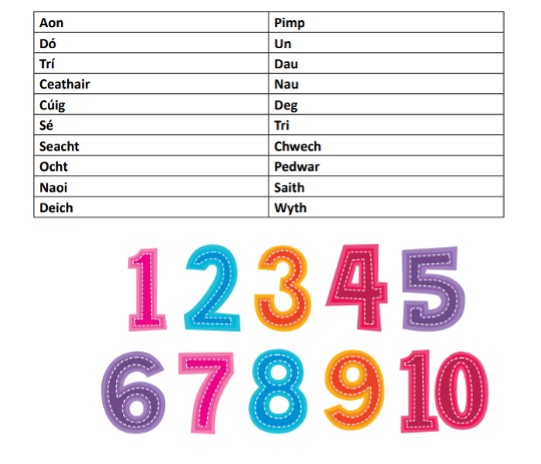
Have a look at more activities to explore the connections between the Irish language and living sustainably in Sceitimíní (Cuid 5).
Have a look at more activities to explore the connections between the Irish language and other languages in Léitheoirí Líofa (Cuid 8) and Sceitimíní (Cuid 4).
!!!! Blog 1: Why wouldn’t you learn Irish? Exploring the creative possibilities of language learning
Why wouldn’t you learn Irish? Exploring the creative possibilities of language learning
Every day from 9 o’clock to 3 o’clock, primary school classrooms across the country are hives of activity. The primary classroom is also the place where one of the largest communities of Irish-language speakers, native and new speakers, come into contact, chat and catch up with each other.
Since Irish was first formally introduced to the primary school curriculum in 1922, teachers have had a crucial role in caring for and helping children to develop holistically. We have amassed experience of over a hundred years of learning and teaching Irish so it is timely to reflect on how the inclusion of Irish has helped nurture our creative selves.
These are for me some of the wonders of learning Irish.
Learning Irish is important for the Arts
There has long been a close connection between Irish and the arts. Early language educators and enthusiasts recognised the role that creative experiences could play in encouraging new speakers of Irish, and to help the Irish-language arts flourish.
When Irish became a core part of the primary curriculum, singing songs in Irish and engaging with traditional arts became part of children’s learning of Irish. Indeed today, when adults asked to think back on positive memories of learning Irish, myths and legends are often recalled vividly, as well as childhood songs, poems and dramas. Children today, still report that they enjoy learning through creative, playful and child-centred methodologies and that they like having a repertoire of rhymes and poems in Irish.
Learning Irish helps children access and enjoy rich Irish-language literature
There is a very rich culture of storytelling in Ireland. Developing literacy skills in Irish gives children access to this wealth of stories, both oral and written. Some of the unique features of Irish-language literature include the special genre of An t-agallamh beirte, a poetic disputation, that has no real parallel in other languages. Access to high-quality contemporary literature in Irish can a positive impact on children’s reading experiences and perceptions of themselves as readers.
The Irish lesson is a space in the curriculum, and in the school day, where children can engage with the arts and develop language skills and creative practices in tandem.