!!!! Clann Lir – Children of Lir: In Our Own Words
In 2024, the children in Maria Mulligan’s second class from Castlebar Primary School, Co Mayo took part in a project entitled ‘Clann Lir – The Children of Lir: In Our Own Words’.
The project combined music, drama, visual arts, literature and digital design to bring a cherished Irish legend to life in a unique and enchanting way. At the heart of the project were three original songs, crafted by the children themselves, along with visual artist and songwriter Sharon Ní Chuilibín, in response to the Lir saga.
Tell us the story of your project – What was the impetus? What was it about? Who was involved? How did you begin?
Phase 1: Teacher Artist Partnership (TAP) Project
We agreed a focus for our TAP project in our first conversation together – the Irish story of the Children of Lir. This emotive story tells the tale of how four children of King Lir are transformed into swans by their jealous step-mother, condemned to 900 years enduring hardship and suffering with only their human voices to tell of their humanity. On hearing the christian bell they regain their human forms as frail aged people and their souls are released. The story ends in Co. Mayo at the island of Inis Glóra bringing the Irish landscape to life in an emotive way and exploring themes of loss and belonging, grief, resilience, family and togetherness.
The class we worked with included children of diverse ethnic and cultural backgrounds from ten countries. We felt the emotion of the story and how themes of grief, longing and belonging and family so resonate with the reality of migration that impacts the lives of so many children around us today. The story of the Chidlren of Lir is expansive and engaging enough to allow everyone to identify with the four characters in the story – Fionnula, Aodh and twins, Fiacra and Conn.
How were the ideas developed and how did the young people, artist and teacher work together?:
Sharon Ní Chuilibín, Artist, Musician, Songwriter
From the start we decided to include both music and visual art activities during my visits to the class. We would begin with the children relaxing to improvised music on low whistle, evoking the atmosphere of the story and I would sing some songs I have composed about nature themes. This provided a comforting atmosphere to nourish imagination and allow a smooth transition from their lessons into a creative frame of mind. Listening to the songs also showed the children how possible it is to create new music and songs themselves. They became familiar with particular songs that they would request each week, such as the Dandelion Song. In the story of the Children of Lir, once the children have been transformed into swans, their human voices are all that remains of their humanity: they are known by their songs.
Composing the new songs came about naturally through conversation with the children. Maria would write words on the board as I asked questions, inviting the children to connect with the Children of Lir characters and imagine what they might have said, or felt at key turning points in the story of the Children of Lir.
Listen to a recording of the composing process in the classroom – recorded by teacher Maria Mulligan:
Our first song, “Bí Sona, Bí Sásta” is the song of the children remembering their mother’s words. “Is bean dubh gránna thú” expresses the anger of the children at being transformed into swans and “900 Years” records the moment of transformation back into human form as elderly people, soon to pass away.
Using recordings of the songs that I had made with the children in class, I combined these with images of their artwork to create videos that the children were able to watch and listen to on YouTube. Maria would play these videos for them to listen to so that they really knew the lyrics. This was helpful when it came to recording the songs with Music Generation Mayo in the second part of the project.
Maria Mulligan, Teacher
Our sessions together were well planned in advance through online meetings via Zoom and discussions on Whatsapp. Each session included some new materials to inspire the project, for example slide shows of the kinds of clothing that people may have worn in the time of the Children of Lir. We looked at images of places referred to in the story and paintings that the story has inspired. These inputs then informed the children’s creative art activities. Working together in groups, they enjoyed free painting on large sheets of paper using natural materials such as leaves, moss, branches exploring the use of texture and colour to create abstract paintings evoking the feathers of the swans, the stormy seas of Moyle and the waters of Inis Glóra. Later on in the project, templates of Irish native tree leaves were traced onto the paintings and these leaf shapes were then cut out and stuck onto large cardboard swans as collage feathers for four swans.
Phase two – Publishing a book and professional recording of songs
Maria Mulligan
The decision to seek funding to develop the project further and create a book with the children was inspired by the rich outputs achieved in the TAP project. We wanted the children to have a momento as it was a special experience for them. Building on the work we had done with Sharon, we had artwork, three original songs and a unique perspective on the story. I enquired with Mayo County Council and was able to apply for a grant through Creative Communities which allowed us to print copies of the book and record the songs.
As part of the TAP project, I had read and discussed the story with the children so they were able to re-tell it in their own words, from memory. In choosing a version for the book, there had to be room for both pictures and the words so it had to be a reduced-down version of the story. Extracts from the children’s re-telling of the story in their copies were used to form the text of the book.
To create images for the book, the children let their creativity flow by constructing accessories for each character from the story using paint, upcycled cardboard, old toys, glue, twigs. flowers and leaves were used to make cloaks, crowns, swan masks and wings. Mostly we used recycled materials; for example, all the cloaks were duvets that they painted. They put glitter and decorations to make them look more ‘royal’
I took photographs of the children wearing their costumes and dramatising the main scenes of the legend through the use of freeze frames. Using the Canva design programme, these photographs were used to create the book with some input from Sharon. The book was then printed by a local printing company.
When all of the hard work was coming to fruition with the recording of the songs and the creation of the book, the book launch was a very important part of the project. It was very important to the children that there was an output that could be shared. We hosted a book and song launch with children’s parents, Councillor Harry Barrett and artist Sharon Ní Chuilibín as special guests.
Watch the children perform their songs at the book launch:
Each child received a printed copy of their book that they will have as a special memory forever. A book was also presented to each class of Castlebar Primary School inviting our school community to immerse themselves in the emotional journey crafted by our young storytellers. The book is also available online on Book Creator with links to the videos and songs.
When the book was created the children were able to say, “Wow! This is really amazing what we have done!”
Like an artist with an art exhibition, I feel that you have to pull it all together and have people view it, to have a celebration and sense of completion. Publishing is really important. If you don’t publish what you’ve done it’s still in draft form, it’s in a messy form. Once you publish, that’s where the pride comes then. I think it is really important.
Sharon Ní Chuilibín
To record the new songs composed with the children, we travelled by bus to Music West in Castlebar where we booked a room for a professional recording session with Philip Cassidy from Music Generation Mayo. Volunteer transition year students, Áine Fitzgerald and Juliette Malloy from Davitt College in Castlebar also came along to support the process. In the weeks leading up to the recording of the songs, we rehearsed the songs together via Zoom and at the school. With Maria’s assistance holding the words and encouraging the children, they were able to sing and perform all three songs. This was a great achievement for the children as they had to stand during the recording process and really pay attention, this required a lot of energy and patience. There was great excitement to see the microphones and recording equipment set up for them in the space of Music West, it was a special day out.
What was your personal experience of the project in terms of successes and challenges?
Maria Mulligan
In working with the “Children of Lir” in such an imaginative and engaging way, I noticed that the children really felt a connection to the characters in the story much more than if they had just read the stories. They explored the characters through art and they had acted and dramatised the characters. Children were invited to feel the emotions of the story to create the abstract artwork. Also, the song-writing really made them think about how those characters were feeling. They got a real sense of how the children of Lir felt when their stepmother turned them into swans, and the anger that they felt. In the song that they composed, “900 years“, they really did think about how that would feel – to live for 900 years; they considered it deeply. They were much more connected with the story. I think they will be connected to that story for ever more because they engaged with it on so many different levels artistically.
They had more of a connection with the Irish language and with the fact that, during the time of the Children of Lir, everyone would have spoken Irish. They had more of a positive attitude to the Irish language and speaking Irish after the project. The fact that this was through song helped them to connect with Irish. They knew what the words meant but also the feeling that came through in the music also told them what the words meant. They’ll never forget what those words mean in Irish. That’s very special and doesn’t always happen when you are teaching a class.
Sharon Ní Chuilibín
The children succeeded in really making the story their own, sharing The Children of Lir in their own words through song, word and image. The children had a personal connection with the character that they dramatised in the book – with one child overheard saying “Ah Finn, that’s me, I am Finn”.
Performance and recording the songs required great stamina and concentration of the children. If any mistakes were made during the recording of the song then it was necessary to restart at the very beginning which was both eye opening as well as being frustrating for some children.
With so much material and creativity from the children it was a challenge to represent all of their work and so I edited three short films to accompany the songs, showing the children at work and the process involved in the project.
What was significant for you about the project that is worth sharing?
Maria Mulligan
At the start of the project, the children were probably a bit inhibited and self-conscious. As time went on, they were less inhibited and more confident. They had a sense of achievement, they had contributed to something and made it their own.
Overall, I saw a very positive impact on the children. They definitely worked better as a team within the class and I found that the morale was better. The children were calmer and more able to be in the moment. They were so proud of what they achieved. The project also contributed to children’s enjoyment of school and their self esteem.
Sharon Ní Chuilibín
The class group that participated in this project included children from 10 nationalities and diverse social backgrounds. For some of the children, English was not their first language, for others, they may not have had the opportunity to collaborate creatively as part of a large group before.
A key value of the project is that everyone’s voice has been heard. The children contributed their thoughts and words to create the songs for the project as well as joining together to sing and record the songs as a group.
In creating the final book of the story in their own words, the children had the opportunity to pose as the characters of the story and truly make it their own. This experience will certainly stay with them all through their lives as a positive and inspiring reminder of the power of creativity and of working together.
As the project culminated in a published book of the The Children of Lir, the children were able to perform a concert of the songs and read the story for their families as a special school occasion. This created strong links between home and school and there was a great sense of celebration and achievement on the day. Teacher and Councillor Harry Barrett commented that the project was one of the best that he had seen in forty years of teaching practice.
In a time when there may appear to be division and concern about the arrival of many different cultures in our towns and villages, this project shows how the old tales of Ireland can bring people together through heart felt themes that we all share. The creativity of the children as they worked together on the project is an inspiration to others for what can be achieved when we work for a shared purpose.
Has anything changed in your work as a result of the project?
Sharon Ní Chuilibín
As an artist, I am more aware of the many ways that a project can have a variety of outcomes and how rewarding it is to compose songs with children. I also pay more attention to documentation, as the process is as important as any outcome. It has been valuable to record and acknowledge the children’s own enjoyment and personal experiences throughout our time together.
I have learned that it really makes all the difference when a teacher is invested and committed, bringing their own creative ideas and thought processes to the making of a collaborative project. In some projects I have, on some occasions, felt more like a tolerated visitor. This highlights the importance of developing an atmosphere of collaboration and mutual respect and to highlight the necessity for a teacher to be ‘on board’ and engaged in the process rather than stepping back and handing over. It is important for teachers to recognise that while they know their children and their community, in most cases, a visiting artist does not. It is an asset when there is an openness to creative process, an emphasis on preliminary groundwork and creative exploration.
Maria Mulligan
I feel that I will be able to take the aspects that worked well from the project and bring them into my own teaching. For example, the children really enjoyed engaging in abstract art so I look forward to doing this again. Group collage was also very mindful and enjoyable for the children. Working with a songwriter as talented as Sharon and creating a bilingual song is something that I would love to do again also. Creating a song about a story really helped the children to deeply consider and connect with the characters from the story and I would like to use this in my work in the future.
Watch the children perform their songs inspired by Children of Lir – “Bi Sona”, “Bean Dubh Ghránna” and “900 years’
!!!! Free Workshops and Tours for Schools at National Museum of Ireland in Mayo
National Museum of Ireland, Turlough Park, Co Mayo
Dates: April – June 2026
From Buttermaking and Biodiversity to an Orienteering Adventure
National Museum in Co. Mayo offers a range of free school workshops and tours this spring.
The National Museum of Ireland at Turlough Park, Castlebar, Co. Mayo, is offering an exciting programme of free workshops and tours for schools throughout April, May and June, providing students with opportunities to connect with Ireland’s cultural heritage and natural environment.
Biodiversity Workshop
This fun and educational Biodiversity Workshop takes place on Thursday, 30 April, with sessions available at 10am and 11.30am. Led by Dr Karina Dingerkus alongside the Museum’s Education team, this hands-on workshop explores minibeasts and wildflowers in the beautiful grounds of Turlough Park.
Designed for 3rd to 6th class primary school students, the workshop includes bug hunts and minibeast identification, a wildflower treasure hunt, pollinator observation, and a nature walk with interactive games.
These free sessions can be booked online.
Buttermaking Demonstrations
In May, students can take part in the Museum’s popular Buttermaking Demonstrations, where they will learn about the origins of traditional buttermaking in Ireland, along with the science, history and cultural significance of dairy production. Pupils will also get the chance to churn cream into butter using traditional methods.
These demonstrations take place every Thursday at 10am throughout May, a time of year long associated with buttermaking and traditional beliefs around protecting the churn and dairy yield from the fairies.
Places are free and booking is available online
Orienteering Adventure Days
Also returning in May are the Museum’s hugely popular Orienteering Adventure Days. Suitable for 4th to 6th class students, these sessions introduce participants to basic map reading and navigation skills before they complete trial runs on an orienteering course set throughout the Turlough Park grounds.
There are various sessions available on Wednesday, 20 May and Thursday, 21 May. These workshops are delivered in partnership with ATU Mayo and Mayo Sports Partnership to celebrate World Orienteering Week.
Places are free and booking is available online.
Guided Tours and Nature Tours
In addition, throughout May and June, the Museum is offering free Guided Tours of the National Folklife Collection and Guided Seasonal Nature Tours in the biodiverse parklands of Turlough Park. These tours are available at 10am and 11.30am on Tuesdays, Wednesdays and Thursdays and can be booked online at the links below.
Guided Tour of the National Folklife Collection
Guided Seasonal Nature Tour
Visit museum.ie for further details of all workshops and tours for primary schools at the National Museum in Turlough Park.
!!!! Children and Family Events at the National Museum of Country Life
The National Museum of Country Life
Dates: July and August
The National Museum of Country Life has lots of free family events during July and August, suitable for children of all ages. Every Saturday throughout the month of July from 2pm to 4pm, you can make your own Paper Bee & Wildflowers at the Nature Craft Station. This is part of the ‘Visit the Murmur of Bees’ exhibition where you can learn all about bees in Ireland and then visit the Nature Craft Station in the Education Rooms in the Museum Galleries. This is a self-guided activity suitable for all ages. No booking is required.
Families are encouraged to pick up the new ‘Woodland Explorer’ activity booklet from Museum reception and explore a self-guided nature trail through the grounds of Turlough Park any time during opening hours. Also during opening hours, families can participate in the Gallery Trail: ‘Find Peadar and his Friends’! Peadar is a Pygmy Shrew who lives at the Museum with his seven friends. Can you find their hiding spots in the Museum galleries using a fun, self-guided activity sheet?
They Museum Music Circle runs from 1pm to 2.30pm on the 1st and 3rd Saturday of each month and is suitable for all Ages. Dust down that fiddle and polish that whistle for the Museum’s Music Circle! Come along to learn, practice, share and play tunes and songs with other musicians.
All events are free and you can get more information here.
!!!! Arts in Education Portal Regional Day 2024 Roundup
Arts in Education Portal
Teachers, artists and arts in eduction professionals gathered in Sligo Education Centre on Saturday last for a day of sharing experience, gathering new ideas and networking with colleagues. This, the eighth of our Portal Regional Days, focused on best arts and creativity in education practice in the Northwest. This year’s gathering also saw attendees travel from Galway and Dublin.
The morning session saw two highly engaging presentations which demonstrated excellent Teacher Creative Practitioner/Artist partnerships. The first was from artist Andy Parsons and teacher Triona O’Dowd Hill who brought to life their process-based, abstract art project undertaken by Triona’s class at St Cecilia’s School, Sligo; a school that caters for students with moderate to profound learning disabilities.⠀The project, facilitated by Kids’ Own Publishing, focused on the partnerships between teacher and artist, and between artist and students. Triona and Andy spoke of the many ways the students asserted their creative voice and the sense of equality brought to the project by inviting TY students from the Ursuline College to participate in a collaborative session. The second presentation was delivered by teacher Karen Brogan and arts professional Leslie Ryan on their Creative Cluster project involving a group of five rural schools in West Sligo. Karen started by describing their project as an adventure, in which they took creativity and the creative arts as a lens in which to explore their local heritage, ecology and environment. They highlighted the benefits and the opportunities that came from working as a Creative Cluster and the impact it had within their schools and wider local communities.
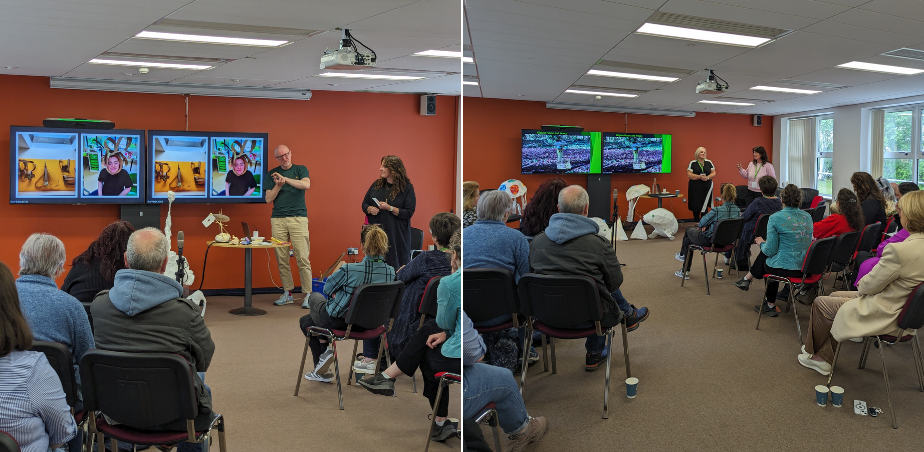
Image: Artist Andy Parsons and teacher Triona O’Dowd Hill (left) and teacher Karen Brogan and arts professsional Leslie Ryan (right) speaking at the 2024 Regional Day
Before breaking for lunch, practical advice was provided through two sector bulletins where attendees heard from Daragh McDaid, Director Sligo Education Centre and Rhona McGrath of Roscommon County Council Arts Office who provide an overview of the supports and initiatives available through ESCI and the Local Authority Arts Offices.
After a morning of sharing practice, the group enjoyed a fab lunch catered by Blend Cafe.
Two creative workshops were available in the afternoon session, these offered attendees fun, stimulating, hands-on activities. Kathleen Gallagher led an interactive art workshop with Scratch and Makey Makey. Participants were encouraged to think outside the box and transform everyday objects into touchpads that interact with computers, bringing the worlds of coding and art together. Meanwhile Maeve Pudney, co-owner of artisan design studio Pop Out Projects immersed participants into the traditional craft of weaving using a bespoke table-top loom and genuine Donegal tweed wool yarn. Participants tried their hand at creating colourful bookmarks and coasters, seeing enormous possibilities for application within the classroom.
Thank you to everyone who joined us on the day. For those who missed the mornings discussions, we recorded both of the main talks and these will be available below:
Episode 01: Collaborations in Abstract Sculpture with Triona O’Dowd Hill, Andy Parsons and Lorna Kavanagh | 2024 Regional Day
A transcript of this recording is available to download – click here
Episode 02: Dúlra agus Dúchas – The Ties that Bind Us; A Creative Cluster Journey from Beach Foraging to Beach Installation with Karen Brogan and Leslie Ryan | 2024 Regional Day
A transcript of this recording is available to download – click here
!!!! 2024 Portal Spring Regional Day – Programme Announced
Arts in Education Portal
Date: Saturday, 25th May 2024
The Arts in Education Portal team are delighted to announce the full programme for our Spring Regional Day on Saturday 25 May in Sligo at Sligo Education Centre.
We invite teachers, artists, arts managers and anyone with an interest in arts in education in Donegal, Mayo, Leitrim, Roscommon and Sligo and beyond to join us for this free event.
The programme for the day includes a series of presentations in the morning; teacher Triona O’Dowd Hill, artist Andy Parson, together with Lorna Kavanagh of Kids’ Own Publishing, will discuss the collaborative journey embarked with Triona’s class in St. Cecilia’s School, a school that caters for students with moderate to profound learning disabilities. Following this discussion, Karen Brogan, a teacher from the West Sligo Creative Cluster will share their cluster journey where they explored themes within ecology and heritage through sculpture, sound and visual art and how they developed new and innovative ways of working co-operatively.
In the afternoon sample some creative spark with the choice between two creative workshops. STEAM facilitator Kathleen Gallagher, will provide educators with comprehensive training on utilising Scratch, a visual programming language, and Makey Makey, a circuit building invention kit, to create interactive art projects. Alternatively join Maeve Pudney to explore colour and pattern through Donegal yarn using a small weaving loom invented through her creative business Pop Out Projects.
How to Book
Tickets for the 2024 Portal Spring Regional Day are free. It is essential to book in advance as capacity is limited.
Book your place at:
https://www.eventbrite.com/e/
– – – – – – – –
Schedule
10:15am — Registration & coffee
10.45am — Welcome & Introduction – The Portal: a brief introduction by Edel Doherty, Kids’ Own Publishing Partnership (Portal Content Manager)
11:00am — Presentation: “Collaborations in Abstract sculpture” with Triona O’Dowd Hill and Andy Parsons
11:30am — Presentation: “Dúlra agus Dúchas: The Ties that Bind Us”; A Creative Cluster Journey from Beach Foraging to Beach Installation with Karen Brogan and Leslie Ryan
12:00am — Bulletins from the Education and Arts sectors
12:15pm — Q & A: whole panel of presenters
12:30pm — Lunch & networking
1:30pm – 3:00pm — Parallel session: choice between two creative workshops:
“Engaging Minds: Interactive Art Workshop with Scratch and Makey Makey” with Kathleen Gallagher
Or
“Learn to Weave Irish Tweed” with Maeve Pudney
– – – – Close – – – –
!!!! Call for presentations and workshops: Portal Spring Regional Day 2024
Deadline extended: 5th April 2024
Artists, teachers, academics and arts education professionals… Would you like to be part of the Portal Spring Regional Day? The Arts in Education Portal Team are seeking submissions for presentations for the Portal Spring Regional Day 2024 with a focus on the North-West Region. This regional event will take place on Saturday 25th May in Sligo at Sligo Education Centre.
The event aims to connect teachers, artists, arts managers and anyone with an interest in art and creativity in education based in the counties around Sligo, Mayo, Donegal, Leitrim and Roscommon.
Practitioners can learn more about the Portal and what it offers, tell us about their work, connect with the community at regional level, share practice and find out what opportunities or events are available in their local area.
We are inviting proposals from organisations or individuals who are involved in arts and creative projects in education in the North-West, and who want to give inspiring presentations or workshops that can offer sharing of skills, practical approaches, new insights and critical thinking across the field, from a range of perspectives.
Do you have a presentation or workshop that you would like to be included in the programme for the Portal Spring Regional Day? If so, please complete your proposal via our online form from the link below. If you have any questions please get in touch by email to editor@artsineducation.ie.
Application Information:
- The programme includes two project presentations with up to two presenters.
- Two creative workshops with one facilitator will be selected.
- All Speakers and Creative workshop facilitators must be based in the North-West Region (Donegal, Leitrim, Mayo, Roscommon and Sligo).
- Deadline: 5pm, 5th April 2024
Proposals should be submitted via Google Forms, click here to access the form.
!!!! National Museum of Ireland: New School Programmes
National Museum of Ireland
Dates: various
The National Museum of Ireland is delighted to launch its latest programme of guided tours, workshops and resources for primary schools for the spring term. Available from January 2024, all activities are offered free of charge and encompass all four Museum sites in Dublin and Co. Mayo.
Each site focuses on a different part of the National Collections with a school programme to reflect the collection on display at each location offering a diverse range of activities to complement the primary curriculum.
Highlights from each location:
GUIDED TOUR: A Taste of the Past – The History of Food and Drink – Collins Barracks, Dublin 7 – 3rd-6th Class
This interactive tour will give students a flavour of the wealth of artifacts on display in the Museum. They show the continuity and change of food preparation over time.
GUIDED TOUR: The Vikings in Ireland – Kildare Street – 3rd-6th Class
The Vikings in Ireland guided tour explores the three main activities of the Vikings – raiding, trading and settling – using the Museum’s unique collection of artifacts.</p
WORKSHOP: Engineers Week: Make a Town – Turlough Park, Castlebar, Co. Mayo – 5th & 6th Class
In this virtual session construct buildings, make roads and paths, cut, colour and create each building and put them into your town layout! Participants may like to decorate with Matchbox cars or figurines and can work from their classroom to expand, make further buildings and perhaps even a whole city with Makermeet!
GUIDED TOUR: Get Stuffed! – Merrion Street, Dublin 2 – Junior Infants-2nd Class
This session is new and specifically designed for junior primary audiences. Make some new friends as we visit the furry deer, feathery puffins, and scaly turtles on a guided tour led by a Museum Educator.
View the full schools programme for the National Museum of Ireland at:
- Decorative Arts & History, Collins Barracks, Dublin 7
- Country Life, Turlough Park, Castlebar, Co. Mayo
- Archaeology, Kildare Street, Dublin 2
- Natural History, Merrion Street, Dublin 2
!!!! Mayo Education Centre: Creative Arts Session for Teachers
Mayo Education Centre
Date: 30th May 2023
Mayo Education Centre invites teachers to a free arts session that will inspire them to experiment and be creative with a variety of materials to create both two and three dimensional artworks. Led by artist Jennifer Hickey “Making the Season Creative with Art” is a practical face to face session, which will encourage participants to explore art making processes using a variety of materials and will deliver an imaginative learning experience that teachers can bring back to the classroom.
Participants will work with a variety of materials including; clay, inks, paint, card and materials from nature.
It is aimed at teachers of all levels of experience and is suitable for teachers in junior and senior classes.
Learning outcomes
• Learn new and easy ways to incorporate natural materials into the classroom.
• Gain knowledge on contemporary artists who explore their environment and use natural materials in their work.
• Explore hands on craft processes that will promote wellbeing and encourage the classroom to respond, explore and interpret the season in a visual and creative way.
Date: 30th May, 7pm – 9pm
Fee: Free
To Book: https://mayoeducationcentre.ie/
!!!! National Museum of Ireland: Schools Spring 2023 Programme
National Museum of Ireland (NMI)
The National Museum of Ireland (NMI) is inviting schools and teachers across Ireland to spring into culture and heritage with a new programme of tours, activities and resources for onsite and online engagement.
The museum has just launched a diverse range of events across four public sites in Dublin and Mayo. Activities include virtual tours, guided tours, self-guided visits, workshops, classroom resources, video resources, wordsearches, arts and crafts and more.
The curriculum-linked programme aims to spark curiosity, stimulate discussion and encourage cultural and heritage engagement through our national collections.
All schools visits are free but must be booked in advance as capacity is limited and varies from site to site.
- Primary level: Browse the full spring 2023 programme
- Post Primary level: Browse the full spring 2023 programme
Here are some of the highlights of the upcoming schedule.
Orienteering Workshop / Post Primary
Learn some basic map reading and navigation skills and complete an orienteering course around the grounds of the National Museum of Ireland – Country Life at Turlough Park in Co Mayo. Booking is required.
PRIMARY / Classroom activity: Ice Age Ireland – Cool Fossils
Use these curriculum-linked activity sheets and video resource to learn more about Ice Age Ireland. In this museum activity, find out about Ice Age Ireland, learn about fossils and the different kinds of animals that lived on your doorstep thousands of years ago.
For the full programme of activities go to https://www.museum.ie/en-IE/News/Schools-programme-2023
!!!! Roundup: A selection of funding opportunities for artists
A selection of some national and local funding opportunities for professional artists working in arts and creativity in education with open deadlines in February and March 2023.
Arts Council of Ireland
Applications are currently open for funding from the Arts Council of Ireland, including Agility Awards and Bursary Awards in a number of art forms.
The Young People, Children and Education Bursary Award supports the professional development of artists by enabling them to spend time developing their practice. The award is specifically focussed on helping artists to improve their capacity to develop or present high-quality arts experiences with or for children and young people. It is open to individual artists and practitioners working in a creative capacity in any artform, including arts facilitators, curators or programmers.
Deadline: 5:30pm, 9 February 2023
More info: https://www.artscouncil.ie/Funds/Young-People,-Children,-and-Education-Bursary-Award/
The Agility Award aims to support individual professional freelance artists and arts workers at any stage in their careers to develop their practice, their work, or their skills.
Deadline: 5.30pm, 9th February 2023
More info: https://www.artscouncil.ie/Funds/Agility-Award-2023/
Fingal County Council
Fingal County Council is delighted to announce the 2023 Artists’ Support Scheme. This strand of funding allows professional artists to avail of up to €5,000 of an award towards travel and professional development opportunities, a residency, or towards the development of work.
Deadline: 4pm, February 24, 2023
More info: http://fingalarts.ie/news/fingal-artists-support-scheme-2023
Galway Arts Office
Galway County Arts Office invites applications from individual artists to develop their arts practice and artistic career under their Artist Support Scheme. The scheme is open to professional artists residing in County Galway at all stages of their career, working in any artform and context.
Deadline: 4pm, February 13, 2023
More info: https://www.galway.ie/en/services/arts/funding/bursary/
Laoise Arts Office
Laois County Council has announced details of grants and opportunities to support the development and presentation of creative and artistic projects in the county in 2023. Through the Artists in Schools Scheme 2023, grants are available for artists’ residencies in schools, to include all art forms. This scheme gives primary and post primary schools the opportunity to select and work with professional artists and explore new arts media.
Deadline: 5pm, 17th February 2023
More info: https://laois.ie/departments/arts/grants-schemes/artists-in-schools-scheme/
Limerick City and County Council
Limerick City and County Council offers grant funding to amateur, community or voluntary groups, or organisations, and individual arts practitioners, which in the opinion of the authority, will stimulate public interest in the arts, promote the knowledge, appreciation and practice of the arts or assist in improving the standards of the arts.
Deadline: 4pm, 22 February 2023
More info: https://www.limerick.ie/council/services/community-and-leisure/culture-and-arts/funding-schemes-and-bursaries/limerick-0
Mayo Arts Office
The Mayo Artist Bursary Award is now open for applications. The Artist Bursary Award aims to support the work of professional artists, working in any artform, at all stages of their career, currently resident in Mayo.
Deadline: 5pm, March 16th, 2023
More info: https://www.mayo.ie/arts/funding/mayoartistbursary
Wicklow Arts Office
This year Wicklow County Council Arts Office are currently accepting applications under their Artist Award Scheme 2023. The scheme assists professional artists in the development of artistic practice by enabling them to explore meaningful ways to make work, test out innovative thinking and grow new ideas. The award supports professional practising artists to develop or realise a particular body of work or to undertake professional development.
Deadline: 4pm, February 27, 2023
More info: https://www.wicklow.ie/Living/Services/Arts-Heritage-Archives/Arts/Funding-Support-Opportunities/Arts-Act-Funding
All information is correct at the time of publishing.
!!!! National Museum of Ireland: Schools Autumn/Winter 2022 Programme
National Museum of Ireland (NMI)
The National Museum of Ireland (NMI) is delighted to invite teachers and students across the country to reconnect with culture over the coming school term with an in-person visit to one of its sites.
The Museum has launched its autumn/winter 2022 programme of tours, events and activities, which educators can use to get up close to history, spark curiosity, encourage learning, and promote enjoyment of culture.
Much of the NMI’s school programme was offered virtually over the past two years due to pandemic restrictions. Many schools enjoyed engaging with the Museum online so there will also still be elements of the programme available to access directly from the classroom.
- Primary level: Browse the full autumn/winter 2022 programme
- Post Primary level: Browse the full autumn/winter 2022 programme
There are four public sites of the National Museum of Ireland now open to the public and available for school visits.
School visits are free but booking is essential for all school groups. Continue reading for some selected highlights from the programme:
Onsite guided tour: Recovered Voices: Stories and Experiences of the Irish at War: 1914-1915
This tour at the Museum of Decorative Arts & History, Collins Barracks is available at primary and post primary level, focuses on the people involved in World War One and how the war impacted their lives.
View more details here.
What’s the Sceál: Objects and Stories
A mix of traditional and contemporary stories linked to artefacts in the National Folklife Collection at the Museum of Country Life, Turlough Park with some of Ireland’s premier traditional storytellers, in collaboration with Poetry Ireland. Available online and onsite for primary and post-primary levels.
View more details here.
New Onsite Workshop: Go Extinct
Discover amazing extinct Irish animals in the Museum of Natural History, Kildare Street in this primary level workshop led by a Museum Educator.
View more details here.
Leaving Certificate Art Tours
An onsite tour at the Museum of Archaeology, Merrion Street specifically designed to cover key objects that appear on the History of Art Leaving Certificate specification and traces the development of art in Ireland from the Neolithic to the 12th century.
View more details here.
For full programme details go to www.museum.ie/en-ie/museums/archaeology/engage-and-learn
!!!! Architects in Schools Exhibition: Student Response Workshops
National Museum of Ireland – Country Life
Dates: 1 May to 30 June 2022
The Irish Architecture Foundation and the National Museum of Ireland invite you to Architects in Schools Exhibition. This is a national exhibition created by Transition Year students, teachers and architects responding to themes of Community, Sustainability and Home.
This exhibition features 2D drawings and 3D models and were made in workshops by young people, in collaboration with architects and teachers. The exhibits are displayed in different locations throughout the Museum. An exhibition map is available to guide you on this exhibition trail. There are a number of objects in the Irish Folklife collection that link to the exhibition themes so keep an eye out for them!
The National Museum of Ireland is facilitating Student Response Workshops in response to the Architects in Schools Exhibition. These school visits are an opportunity for students participating in Architects in Schools to meet each other and share their views and ideas. As part of their visit, they will participate in a workshop facilitated by an architect.
Dates: 1 May to 30 June 2022
For more information on the Architects in Schools Exhibition or to book your school slot on a Student Response Workshop, please see www.museum.ie/en-IE/Museums/Country-Life/Exhibitions/Architects-in-schools
!!!! Resource: Mayo County Council’s A Splash of Blue
Mayo County Council Arts Service & Kids’ Own Publishing
Primary school resource
A Splash of Blue is a Schools Exhibition and classroom resource available on loan from Mayo County Council Arts Service to primary schools in County Mayo. The artworks in the exhibition are part of the Mayo County Council Collection and are by artists from or living in Mayo, or who had an exhibition in the county.
A Splash of Blue is an initiative of Mayo County Council Arts Service in collaboration with Kids’ Own Publishing and was developed to make the collection accessible to schools and show children how to explore artworks through looking, thinking, talking and responding in creative ways such as art, writing, music and more.
The collection and accompanying resource A Splash of Blue is available now to tour to schools in County Mayo. This booklet is jam packed with children’s thoughts and ideas on how to engage with the artworks in a fun way while they are at your school. So now you can become a creative explorer too and use this booklet to support you on your journey of discovery of the Schools Exhibition.
If you would like your school to become a creative explorer and to use ‘A Splash of Blue’ to support you on your journey of discovery of the Schools Exhibition, simply email mayoarts@mayococo.ie or call 09490 64666 to arrange a tour of the collection to your school.
For more information see: www.mayo.ie/arts/programme/youth-art/schools-exhibition
!!!! Event: Wire, Strings & Other Things music performance
Linenhall Arts Centre
Date: 10:15am, Tuesday 22 February 2022
Linenhall Arts Centre invites your school to ‘Wire, Strings & Other Things’. This music performance encourages you to always be curious. To listen, respond to and communicate through the sounds, music and stories that are all around you – wherever you are and whoever you are with.
Meet Ed, Andrea and James, three totally different people with one thing in common – they are crazy about music and sound. Anything can happen as they find each other and start to invent music together. What stories will they share when, with your help, they explore the magic and mystery of how to compose, perform and improvise?
Perfect for all primary school classes, Wires, Strings and Other Things links in with the Listening and Responding strand units of the Music curriculum. It fosters a sense of excellence in and appreciation of new music. Through storytelling and composing, this show encourages an awareness and sensitivity to the inter-related elements of music and musical understanding. Experiencing this live music performance means children will see and hear outstanding musicians performing brand new music on a range of instruments including the viola, bass clarinet and improvised musical instruments made from a variety of objects.
Date: 10:15am, Tuesday 22 February 2022
Suitable for students ages 6 and up. Pre-booking essential.
For more information, see thelinenhall.ticketsolve.com/shows/873630591
!!!! New Music Generation Development Officers appointed in Cavan/Monaghan, Galway City and Mayo
Music Generation
Music Generation is delighted to share news of the appointment of three new Music Development Officers in Cavan/Monaghan, Galway City and Mayo.
Mairéad Duffy has taken up the position at Music Generation Cavan/Monaghan, one of the most recent Local Music Education Partnerships (LMEPs) to commence participation in Ireland’s national music education programme, led by Cavan and Monaghan Education and Training Board with support from Cavan and Monaghan County Councils.
Karen Dervan has commenced the role at Music Generation Galway City, another new LMEP under the leadership of Galway and Roscommon Education and Training Board together with Galway City Council.
One of the first LMEPs established as part of Music Generation, Mayo now welcomes Laurie Barrett as new Music Development Officer. Mayo, Sligo and Leitrim Education and Training Board is the lead partner on this programme.
In their new posts, Mairéad, Karen and Laurie will have responsibility for developing and managing affordable and accessible local performance music education programmes for children and young people ages 0 to 18.
This will include the coordination of music tuition services within the counties, working in partnership with schools, community music groups and centres in the formation of choirs, ensembles, multi-genre performance initiatives, and more.
Initiated by Music Network, Music Generation is co-funded by U2, The Ireland Funds, the Department of Education and Skills and Local Music Education Partnerships.
For further information go to https://www.musicgeneration.ie
!!!! A Journey with our Children
Tell us the story of your project – What was the impetus? What was it about? Who was involved? How did you begin?
This project was a collaboration between early childhood educators at Woodland Park preschool in Westport; Karen O’Brien, Mary Skillington, Joanna Kuruc, Kasia Rymarczyk, Bridgit McNamara, Ciara MacNally, Erszi Whyte and resident visual artist Lucy Hill. The collaboration between artist and early years setting began in 2007. The early years setting was located in a building that was previously a primary school and so had a large site with an excess of classrooms. An arrangement was made to use one of the classrooms as a studio space in exchange for collaborating on visual art projects including creating temporary play environments for the children with materials sourced from the Creative Resource Centre.
This particular documentation project grew out of many conversations. There was a strong desire to try to highlight the very many ephemeral moments at preschool where children display positive learning dispositions that could easily be invisible to adults or even understood as ‘mis-behaviour’. The project was grounded in the belief that very young children are competent, capable learners who demonstrate an explorative attitude as they ‘re/present’ their ideas, thoughts and feelings with multiple mediums. Much of the learning, discoveries, creativity and innovations of very young children happen in front of our eyes but need to be framed in understandable ways in order for adults to fully grasp the power and impact of what is unfolding. So for this project, there was no theme, no direction, no grand plan other than this question of how to capture children’s agency in the tiniest everyday moments that may be deeply impactful as an education tool for adults if framed in an understandable way and so the idea for a book document developed. The book would then provide a reflective tool for children where they could visit and revisit their creations in partnership with peers, educators and their parents.
How were the ideas developed and how did the young people, artist and teacher work together?
The children followed the everyday routines of work and play within the preschool day. During free play children made choices as they selected materials and explored the affordances of these materials. The artist and educators together captured many photographs, conversations and children’s everyday activities over several months. There were weekly meetings which explored children’s lines of enquiry and observed interests. These were followed with discussion on how the documentation was developing, what was being captured, what could be found through knowledge of individual children and the particular schema they may be working within. The relational foundation between educators and children was fundamental to revealing the value of the moments being captured where knowledge of individual children’s interests, personalities and competencies was crucial. The artist as documenter was able to take a ‘bird’s eye’ view of the everyday. The main headings within the document emerged slowly through the editing and discussion process. It felt important to allow sufficient time for the project and so it happened in a very unhurried way over several months. An exhibition was planned for Westport library in order to celebrate the children’s artwork and provide visibility of their learning to the wider community. Key competencies were highlighted and dispositions such as involvement, persistence, problem solving and creativity were exemplified through a display of poster pages.
What was your personal experience of the project in terms of successes and challenges?
Artist: My personal experience of the project was an awareness of the delicacy and responsibility implicit in documenting young children’s work and play practices. At all costs we wanted to avoid moments that might frame children from an adult’s aesthetic or that could be seen as a promotional tool. The purpose was to try to get to the core of what was occurring for the children, often using the children’s voice. In the end, the photographs used were all taken by the educators themselves, and included the messiness of the working space, the un-staged every-day. I helped with the design of the document and putting it together but each of the educators also had full access to the editing process and there was much discussion around what should go where and there was no time deadline imposed. Mary took responsibility for the main body of text in the book and Joanna took responsibility for the exhibition design and layout.
Educators: This project provided us with an opportunity to reflect on the learning which took place as children engaged with each other and the environment. Through observation we began to recognise the affordances the environment offered as children engaged with a wide variety of materials. Decisions about what to document was a challenge as there was an abundance of images and narratives collected.
What was significant for you about the project that is worth sharing?
Long term collaborations between artists and educators are hugely useful, interesting and valuable scenarios from which children and adults equally stand to benefit and learn.
Has anything changed in your work as a result of the project?
Artist: This project had a significant impact on my practice. It has led to us collaborating on my current PhD project. Within the research, the focus on what is unfolding for the children can be accessed in a very privileged way, due to the trust and respect that has been established over the past ten years. I am very grateful for the continuous openness, generosity and opportunities to learn.
Educator: The artist provided alternative perspectives on children’s creative and communicative potentials as we worked together to promote children’s developing ability to symbolically represent their ideas with clay, constructions, drawings, and paintings. The artist opened us up to the tools and the need to communicate children’s understandings through various media. As we collected and contemplated transcripts of children’s conversations and detailed renderings of their developing understandings, we also began to refine our own form of symbolic representation. Working with an artist prompted us to advocate for more reciprocal adult–child conversations. Over time, documentation became more integral to our practice, illustrating the principle that culturally constructed ways of life depend on “shared modes of discourse for negotiating differences in meaning and interpretation” (Bruner, 1990, p. 13).