GAEILGE

NEWSLETTER SIGN UP


We’re delighted to continue our guest blog series, sharing perspectives from the arts in education programme, Creativity in the Classroom.

A Butterfly, a House, a Garden: Improvisation, transformation and play in making art together
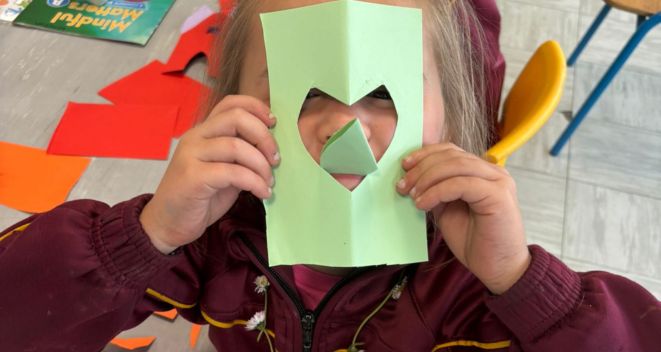
student holds a light green card with a love heart cut out in front of their face

A student participating in Creativity in the Classroom with Duffy Mooney-Sheppard

“That reminds me of…”

I began working as an artist with Creativity in the Classroom in 2024. What I love most is the opportunity to become embedded in the school community, getting to know the children, teachers, and staff over time. This closeness brings something rare to my facilitation, something I genuinely treasure: inspiration comes from them, from where they are, and from what we make together.

I never arrive with a full plan for the six weeks. We start somewhere, and I respond week by week to what emerges. I’ll often open a session by saying…

“Last week when you did this, it made me think of…” or “Remember when you said this reminded you of …”

I’ve come to see how important it is to share this thinking with them. They get to witness an artist making associations and connections, using one thing to ignite the next, something entirely natural in play, and something they do instinctively. Seeing it reflected in our time together gives our making and collaboration a sense of meaning and momentum.

Two Senior Infant Classes, March – May 2026

It began with a butterfly trapped in my shed, the first one I’d seen that year. We watched a short video I took of its capture and release, then talked about the signs of spring we’d each been noticing. From there, we got our hands into scrunched paper and masking tape. The children noticed that at this stage what we’d made looked like cocoons. We added wings and antennae, transforming them into butterflies. When they were finished, we danced together around the classroom, visiting flowers represented by battery-operated lights scattered around the room. As we moved, we discovered, to my surprise, that the wings made a sound when they flapped to the music.

Butterflies led us naturally to flowers, and to one of my favourite picture books — The Boy with Flowers in His Hair by Jarvis. Using strips of coloured card, we experimented with bending, rolling, and sticking in different ways to create large, flower-inspired constructions. From simple beginnings the work became wonderfully involved and complex — masks, crowns, elaborate neckpieces, and things that reminded us of houses or bouncy castles.
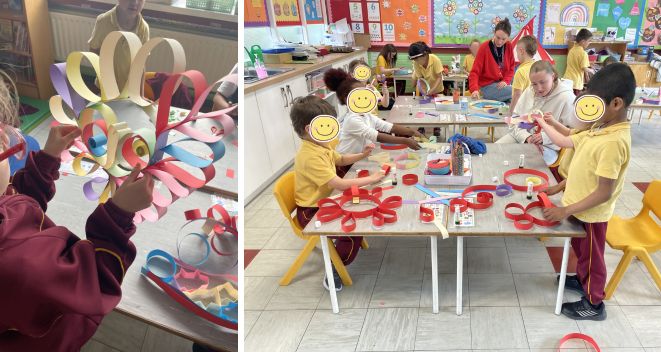
2 photos showing students in a classroom creating from colourful strips of card

Later we looked at these alongside images of the fantastical architecture of Dr. Seuss and the extraordinary buildings of Gaudí, then we turned to cutting card. Fold the card and cut: a semicircle opens into a circle, a triangle becomes a diamond, random cuts produce a star. We took suggestions from the group: can we cut a stairs? and figured things out together. We were thinking with our scissors. We began sticking the shapes together and they became houses, some became rockets, and we fixed them to watercolour sheets with Blu Tack.

The following session, we looked again at the flowers, insects, and animals you might find in a garden, on the walk to school, or in the park. In one class I heard about a ladybird found on the way to school, brought into class and kept in a jar as a class pet before being released later that day. Inspired by these images and stories, we painted across our watercolour sheets, then near the end gently peeled away the Blu-Tacked houses, finding their negative shape in each garden.
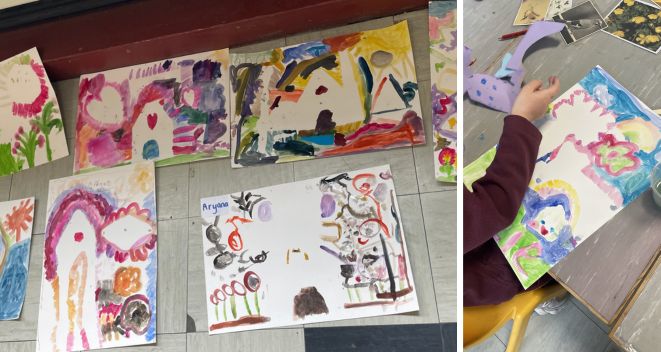
Colourful drawings

On reflection, all of our work had been about transformation. A caterpillar becomes a butterfly. A strip of card, bent or rolled, becomes something sculptural that surprises even the hand that made it. A sheet of card, folded and cut, holds its secret until you open it: what went in as a triangle comes out as a diamond, what went in as a semicircle becomes a circle. And lifting a shape from wet paint, finding its exact outline left behind, brought real gasps. Something was there, now gone, and yet it left its mark. That absence becomes the image.

In truth, of course some days feel wobbly and we are a little bit lost and other days we are moving together, inventing, sharing, ideas flowing. On this, I have to thank the teachers and SNAs at St. James’s for welcoming these creative experiments warmly into their classrooms. And while I set out to facilitate these moments of flow and discovery for the children I work with, experiencing this together, being part of their joy and delight, gives me so much motivation and inspiration as an artist.
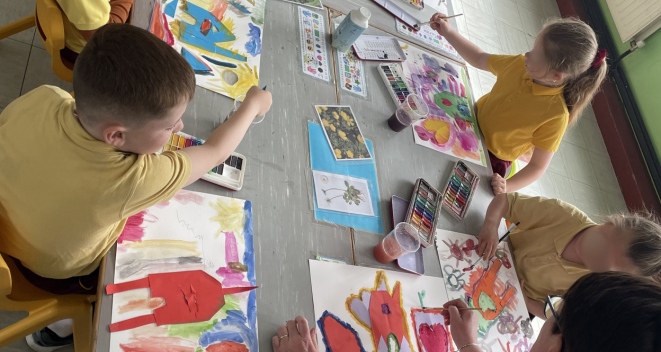
All image credit: Senior Infants from St James National School, Dublin 8 taking part in Creativity in the Classroom. Photo credit: Duffy Mooney-Sheppard

We’re delighted to continue our guest blog series, sharing perspectives from the arts in education programme, Creativity in the Classroom.

Creativity in the Classroom: Colour, Curiosity and Collaboration

As a visiting artist working through Creativity in the Classroom, I’m fortunate to spend up to nine weeks at a time with each class group. That time matters: it gives children full authorship over their ideas, space to develop, and the confidence that comes from genuine collaboration. This term I worked with 5th Class boys and girls from Presentation Primary School Warrenmount, Dublin 8 and their energy shaped the whole project.

Getting started

We began with colour mixing, exploring a palette of blues, yellows and reds. Working in groups, each team used a hula hoop and circular templates to create intersecting shapes across large sheets of paper. These shapes became dedicated spaces for experimenting with colour. The children negotiated how to divide the page, shared discoveries, and surprised themselves with the range of tones they created together.
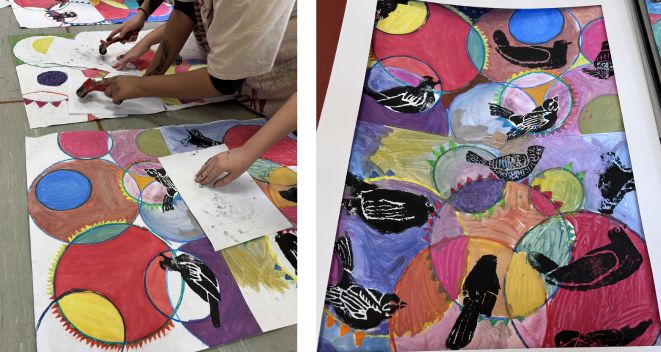
Colourful drawings with circles and bird shapes

5th Class students create colourful shapes during Creativity in the Classroom

Drawing techniques

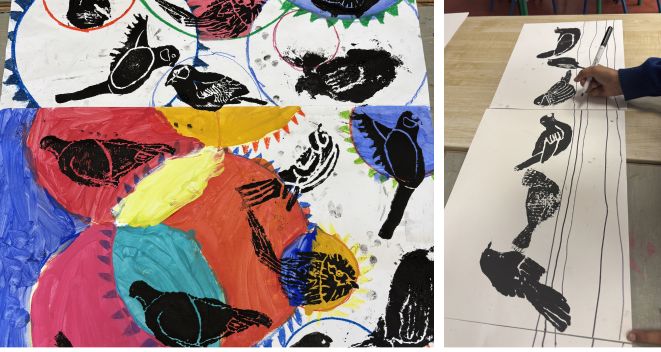
Over the next sessions, we shifted into drawing techniques using 2B, 4B and 6B pencils. I brought in images of birds and demonstrated how I approach a drawing—where to begin, how to fill the page, and why mistakes are part of the process. The children started with A4 studies before enlarging their drawings to A3, focusing on observation, shading and texture. Their concentration and excitement for this technical challenge were remarkable.
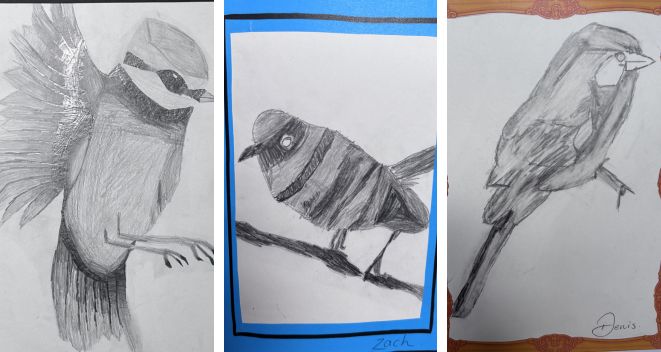
3 pencil drawings of birds for Creativity in the Classroom

5th Class students pencil drawings of birds

Printmaking

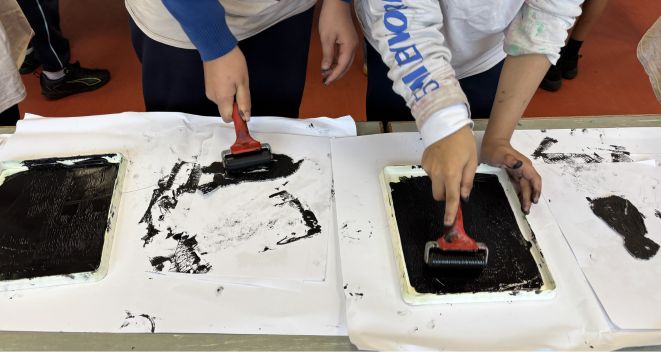
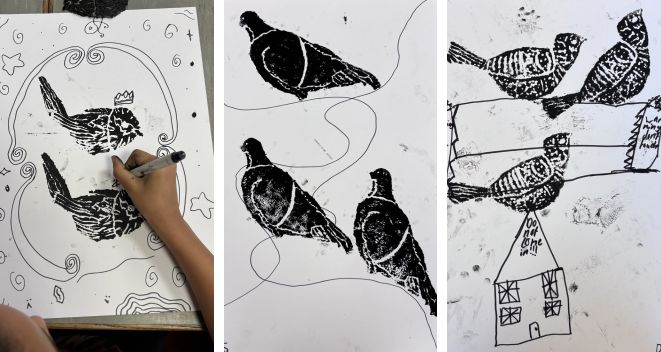
When they were ready, they prepared their drawings for printmaking. Each child simplified their bird, transferred it onto foam board, and added texture through mark making. Printmaking with a large group can be lively, but with the right setup the children can take full control. Using their earlier colour‑mixing sheets as backgrounds, they produced vibrant collaborative prints, along with individual A3 prints finished in black marker. The results were joyful, confident and entirely their own.
In the first post of a new guest blog series, visual art facilitator Liz McMahon reflects on her 27 years of experience working on the Creativity in the Classroom arts in education programme.

Creativity in the Classroom is an artist – teacher collaborative programme involving five primary schools in Dublin 8 and 12. Established in 1997, this innovative school-based arts programme was set up in the belief that the arts could actively and positively support the emotional and social wellbeing of the children in the area.

The success and longevity of Creativity in the Classroom (CIC) is due to a total commitment from the participant schools. Due to this strong belief in the CIC process, each participating school contributes €3,000 from its DEIS grant, totalling €15,000. The vibrant CIC steering committee consists of a member from each school and one of the artists. The committee raise the remaining amount of €15,000 each year via a variety of grant applications. The CIC programme engages approximately 875 pupils annually, with each taking part in at least six sessions.

The CIC committee continually reflect and plan throughout the project, which keeps it up to date on the needs of the children. Wellbeing has now been recognised as a necessity for learning, and it’s been at the heart of CIC since it’s inception.

Twenty nine years ago CIC realised that the visual arts helped children to express and make sense of their emotions, in particular when they might not always have the words to describe what they’re feeling.

It’s easy to lose the original principles of a project over time however the results of the steering committee meetings are fed back to the teachers and artists who participate in the schools. Time is always given to the artist and class teacher to meet throughout the sessions. Every teacher and artist’s relationship differs but all have the children’s wellbeing at heart.

Visual Artist Liz McMahon and a student with a sculpture made from twigs and moss during Creativity in the Classroom

Visual Artist Liz McMahon and a student working together for Creativity in the Classroom programme.

Rather than instructing, the adults scaffold the learning/playing by asking open-ended questions, extending creativity, and introducing new ideas through story, materials, techniques, exploring and wondering. The teacher and artist share their observations and reflect on each session to plan for the next.

During my time working on CIC I experienced extraordinary changes in children, the relationships between children with each other and with the teacher. Towards the end of a series of sessions the children invited their parents to work with them. Some parents who did not have a relationship with the school and had not come in for any other meetings came to these sessions.

Creativity in the Classroom was a recipient of an Arts in Education Portal 2025 Documentation Award.  You can watch the Documentation video below:


!!!! Blog 3: Duffy Mooney-Sheppard, Visual Artist with Creativity in the Classroom

We’re delighted to continue our guest blog series, sharing perspectives from the arts in education programme, Creativity in the Classroom.

A Butterfly, a House, a Garden: Improvisation, transformation and play in making art together

student holds a light green card with a love heart cut out in front of their face

A student participating in Creativity in the Classroom with Duffy Mooney-Sheppard

“That reminds me of…”

I began working as an artist with Creativity in the Classroom in 2024. What I love most is the opportunity to become embedded in the school community, getting to know the children, teachers, and staff over time. This closeness brings something rare to my facilitation, something I genuinely treasure: inspiration comes from them, from where they are, and from what we make together.

I never arrive with a full plan for the six weeks. We start somewhere, and I respond week by week to what emerges. I’ll often open a session by saying…

“Last week when you did this, it made me think of…” or “Remember when you said this reminded you of …”

I’ve come to see how important it is to share this thinking with them. They get to witness an artist making associations and connections, using one thing to ignite the next, something entirely natural in play, and something they do instinctively. Seeing it reflected in our time together gives our making and collaboration a sense of meaning and momentum.

Two Senior Infant Classes, March – May 2026

It began with a butterfly trapped in my shed, the first one I’d seen that year. We watched a short video I took of its capture and release, then talked about the signs of spring we’d each been noticing. From there, we got our hands into scrunched paper and masking tape. The children noticed that at this stage what we’d made looked like cocoons. We added wings and antennae, transforming them into butterflies. When they were finished, we danced together around the classroom, visiting flowers represented by battery-operated lights scattered around the room. As we moved, we discovered, to my surprise, that the wings made a sound when they flapped to the music.

Butterflies led us naturally to flowers, and to one of my favourite picture books — The Boy with Flowers in His Hair by Jarvis. Using strips of coloured card, we experimented with bending, rolling, and sticking in different ways to create large, flower-inspired constructions. From simple beginnings the work became wonderfully involved and complex — masks, crowns, elaborate neckpieces, and things that reminded us of houses or bouncy castles.

2 photos showing students in a classroom creating from colourful strips of card

Later we looked at these alongside images of the fantastical architecture of Dr. Seuss and the extraordinary buildings of Gaudí, then we turned to cutting card. Fold the card and cut: a semicircle opens into a circle, a triangle becomes a diamond, random cuts produce a star. We took suggestions from the group: can we cut a stairs? and figured things out together. We were thinking with our scissors. We began sticking the shapes together and they became houses, some became rockets, and we fixed them to watercolour sheets with Blu Tack.

The following session, we looked again at the flowers, insects, and animals you might find in a garden, on the walk to school, or in the park. In one class I heard about a ladybird found on the way to school, brought into class and kept in a jar as a class pet before being released later that day. Inspired by these images and stories, we painted across our watercolour sheets, then near the end gently peeled away the Blu-Tacked houses, finding their negative shape in each garden.

Colourful drawings

On reflection, all of our work had been about transformation. A caterpillar becomes a butterfly. A strip of card, bent or rolled, becomes something sculptural that surprises even the hand that made it. A sheet of card, folded and cut, holds its secret until you open it: what went in as a triangle comes out as a diamond, what went in as a semicircle becomes a circle. And lifting a shape from wet paint, finding its exact outline left behind, brought real gasps. Something was there, now gone, and yet it left its mark. That absence becomes the image.

In truth, of course some days feel wobbly and we are a little bit lost and other days we are moving together, inventing, sharing, ideas flowing. On this, I have to thank the teachers and SNAs at St. James’s for welcoming these creative experiments warmly into their classrooms. And while I set out to facilitate these moments of flow and discovery for the children I work with, experiencing this together, being part of their joy and delight, gives me so much motivation and inspiration as an artist.

All image credit: Senior Infants from St James National School, Dublin 8 taking part in Creativity in the Classroom. Photo credit: Duffy Mooney-Sheppard

!!!! Blog 2: Deirdre O’Reilly, Visual Artist with Creativity in the Classroom

We’re delighted to continue our guest blog series, sharing perspectives from the arts in education programme, Creativity in the Classroom.

Creativity in the Classroom: Colour, Curiosity and Collaboration

As a visiting artist working through Creativity in the Classroom, I’m fortunate to spend up to nine weeks at a time with each class group. That time matters: it gives children full authorship over their ideas, space to develop, and the confidence that comes from genuine collaboration. This term I worked with 5th Class boys and girls from Presentation Primary School Warrenmount, Dublin 8 and their energy shaped the whole project.

Getting started

We began with colour mixing, exploring a palette of blues, yellows and reds. Working in groups, each team used a hula hoop and circular templates to create intersecting shapes across large sheets of paper. These shapes became dedicated spaces for experimenting with colour. The children negotiated how to divide the page, shared discoveries, and surprised themselves with the range of tones they created together.

Colourful drawings with circles and bird shapes

5th Class students create colourful shapes during Creativity in the Classroom

Drawing techniques

Over the next sessions, we shifted into drawing techniques using 2B, 4B and 6B pencils. I brought in images of birds and demonstrated how I approach a drawing—where to begin, how to fill the page, and why mistakes are part of the process. The children started with A4 studies before enlarging their drawings to A3, focusing on observation, shading and texture. Their concentration and excitement for this technical challenge were remarkable.

3 pencil drawings of birds for Creativity in the Classroom

5th Class students pencil drawings of birds

Printmaking

When they were ready, they prepared their drawings for printmaking. Each child simplified their bird, transferred it onto foam board, and added texture through mark making. Printmaking with a large group can be lively, but with the right setup the children can take full control. Using their earlier colour‑mixing sheets as backgrounds, they produced vibrant collaborative prints, along with individual A3 prints finished in black marker. The results were joyful, confident and entirely their own.
!!!! Blog 1: Liz McMahon, Visual Artist with Creativity in the Classroom

In the first post of a new guest blog series, visual art facilitator Liz McMahon reflects on her 27 years of experience working on the Creativity in the Classroom arts in education programme.

Creativity in the Classroom is an artist – teacher collaborative programme involving five primary schools in Dublin 8 and 12. Established in 1997, this innovative school-based arts programme was set up in the belief that the arts could actively and positively support the emotional and social wellbeing of the children in the area.

The success and longevity of Creativity in the Classroom (CIC) is due to a total commitment from the participant schools. Due to this strong belief in the CIC process, each participating school contributes €3,000 from its DEIS grant, totalling €15,000. The vibrant CIC steering committee consists of a member from each school and one of the artists. The committee raise the remaining amount of €15,000 each year via a variety of grant applications. The CIC programme engages approximately 875 pupils annually, with each taking part in at least six sessions.

The CIC committee continually reflect and plan throughout the project, which keeps it up to date on the needs of the children. Wellbeing has now been recognised as a necessity for learning, and it’s been at the heart of CIC since it’s inception.

Twenty nine years ago CIC realised that the visual arts helped children to express and make sense of their emotions, in particular when they might not always have the words to describe what they’re feeling.

It’s easy to lose the original principles of a project over time however the results of the steering committee meetings are fed back to the teachers and artists who participate in the schools. Time is always given to the artist and class teacher to meet throughout the sessions. Every teacher and artist’s relationship differs but all have the children’s wellbeing at heart.
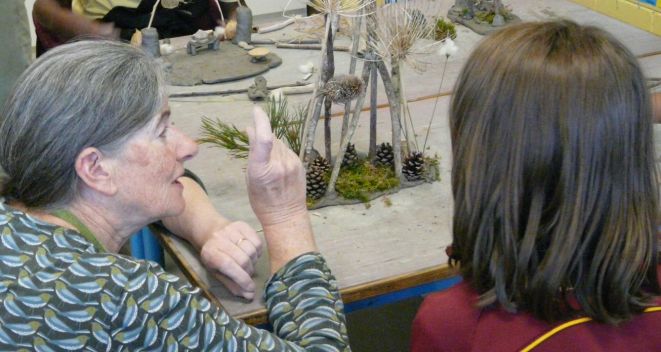
Visual Artist Liz McMahon and a student with a sculpture made from twigs and moss during Creativity in the Classroom

Visual Artist Liz McMahon and a student working together for Creativity in the Classroom programme.

Rather than instructing, the adults scaffold the learning/playing by asking open-ended questions, extending creativity, and introducing new ideas through story, materials, techniques, exploring and wondering. The teacher and artist share their observations and reflect on each session to plan for the next.

During my time working on CIC I experienced extraordinary changes in children, the relationships between children with each other and with the teacher. Towards the end of a series of sessions the children invited their parents to work with them. Some parents who did not have a relationship with the school and had not come in for any other meetings came to these sessions.

Creativity in the Classroom was a recipient of an Arts in Education Portal 2025 Documentation Award.  You can watch the Documentation video below: