Refine by Region
Refine by Art Form
Refine by School Level
Open Road
Open Road was a public artwork created by artist Kathi Burke in collaboration with children and young people from diverse communities across Cork city. Developed as a Glucksman project, it was supported by curator Tadhg Crowley and the Glucksman facilitation team. The project invited the children to become co-creators in the design and creation of the artwork, placing children’s ideas, stories, and aspirations at the heart of the creative process. Tadhg and Kathi share their experiences and insights from the project and how it has informed subsequent programmes.
Tell us the story of your project – What was the impetus? What was it about? Who was involved? How did you begin?
Open Road was a Glucksman project designed to amplify the voices of children from marginalised communities and celebrate their creativity in the public realm. In 2021, the Glucksman invited artist Kathi Burke to create Cork’s first-ever asphalt artwork with a group of children who have fewer opportunities to engage in cultural, artistic, and creative programmes. The children, aged 6–12, came to the Glucksman Museum from Mayfield Youth Café and Good Shepherd Cork to work collaboratively with the artist, learn creative skills, and shape the design of a unique public artwork.
The Glucksman is an inclusive organisation that invites diverse communities of interest and place to access and contribute to its programmes. The museum has established partnerships with Good Shepherd Cork, an organisation that supports women and families experiencing homelessness, and Mayfield Youth Café, a community-led organisation providing extracurricular opportunities and support for primary school-aged Traveller girls. Through conversations with community support workers, a need and interest in a large-scale creative project that would celebrate these young people was identified. As outlined by Rose Morris, Making Change Coordinator at Good Shepherd Cork:
“The children and young people we work with are not only undergoing the trauma of homelessness but have often experienced other fractures and significant difficulties in their lives. We find art to be a fantastic vehicle for them to express themselves and to develop their self-confidence and creativity.”
Open Road invited the children to take part in a truly unique project: the design and creation of Cork city’s first asphalt artwork. Research revealed many examples across the U.S. where artists and collectives had painted directly onto public streets, walkways, and plazas. While there were some instances of asphalt artworks in Irish playgrounds and schools, at the time no public streets in Ireland had been identified as having been used in this way. Conversations with Cork City Council representatives confirmed that this would be the first artwork of its kind in the city. Excitement at bringing such a project to Cork was tempered by the challenges of convincing stakeholders of its value in relation to perceived risks.
Funding was awarded to artist Kathi Burke through the Arts Council of Ireland YPCE Project Award. The project began in April 2021 and concluded in June 2021 with the installation of the artwork during Cruinniú na nÓg and Cork Midsummer Festival.
How were the ideas developed and how did the young people, artist and teacher work together?
Open Road was designed so that the children were co-creators of the public artwork. As Kathi Burke noted, “My creative practice spans illustration, design, art, and writing, and I am drawn to collaborative work because of what happens when you make space for other people’s imaginations (especially children’s) within these disciplines.”
The sessions, led by Kathi Burke and Glucksman facilitators, introduced art-making techniques and encouraged participants to develop stories and drawings based on their dreams. The artist interpreted the material produced by the children to identify common themes, concerns, and aspirations.
The Glucksman uses the Lundy Model in creative projects with young people. Developed by Professor Laura Lundy, the model is built upon four elements:
Voice: children must be supported to express their views in a way that works for them.
Space: children must be given safe, inclusive opportunities to form and express their views.
Audience: their views must be heard by those with the capacity to effect change.
Influence: their views must be acted upon, where appropriate.
Working closely with community support workers, the sessions were designed to encourage full participation. While the concept of creating a public artwork was introduced to the children, they retained control over the content, meaning, and message of the work. They also influenced the workshop format, materials, and activities.
A key objective of the workshops was to support children in developing a range of creative skills that would enable them to communicate their ideas and experiences—not only during the project but into the future.
Over the spring, three groups of children attended two workshops each. The sessions began with a gentle approach to build confidence and draw out ideas. Each child received an art pack, including a sketchbook, pencils, and colouring pencils, allowing them to develop their ideas both during sessions and between visits to the museum.
Kathi Burke designed templates to support children with less confidence, helping them begin to visualise their ideas. Insights from the initial workshops informed the development of subsequent sessions.
Food played an important role. Conversations about favourite foods naturally emerged during the lunches provided, which were an essential element of care during the children’s visits. From these discussions, the idea of a picnic in the city emerged.
Further ideas followed, centred on making the city more fun and colourful—a child-friendly space that encourages play.
The snake motif emerged during a chalk-drawing workshop when one participant began sketching a snake, and others joined in, decorating it with flags representing the different nationalities present.
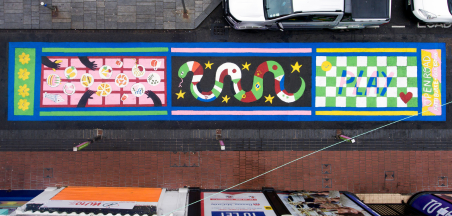
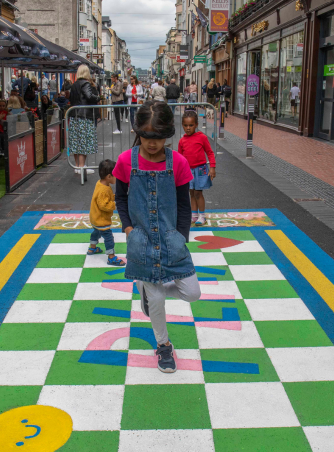
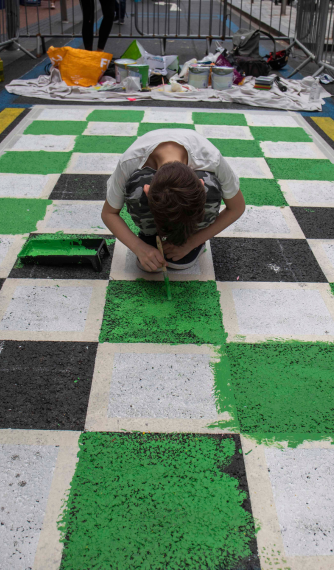
Kathi Burke’s final design brought these elements together. The artwork featured three sections: a green and white checkerboard with the word play, the snake with flags, and a picnic blanket displaying the children’s favourite foods. Together, these elements functioned like a hopscotch game, encouraging people to jump along the checkerboard, run alongside the snake, and hop across the picnic plates.
What was your personal experience of the project in terms of successes and challenges?
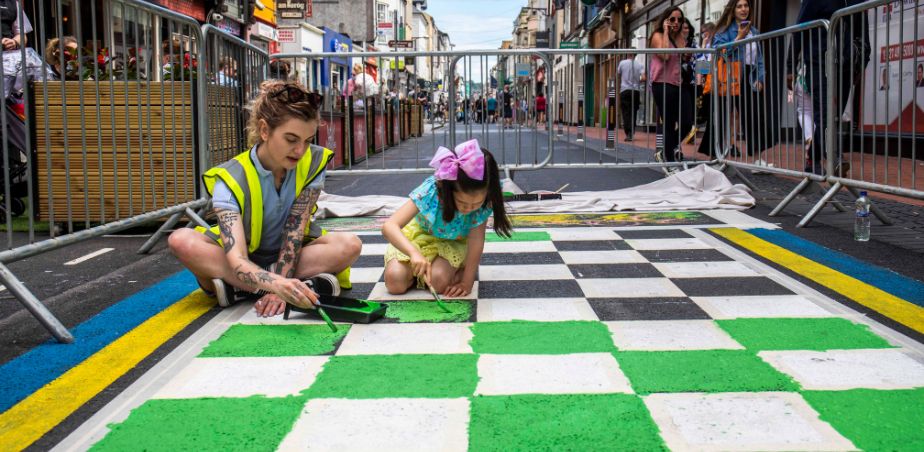
In June 2021, the artist and participating children painted their design onto Oliver Plunkett Street, a pedestrianised area in Cork city centre. A short film by photographer and filmmaker Clare Keogh documents how Kathi Burke incorporated the perspectives of the young participants and transformed their ideas into an imaginative urban intervention.
Cork City Council initially proposed locating the artwork on a smaller street on the outskirts of the city centre. While this offered the potential for a longer-term installation, it lacked the visibility central to the project’s aims. Siobhán Clancy, Community Arts Coordinator, and Erin O’Brien, City Centre Coordinator, provided invaluable support by liaising across council departments and advocating for a more prominent location. Ultimately, Oliver Plunkett Street was proposed and accepted.
One of the city’s main shopping streets, Oliver Plunkett Street won The Great Street Award in 2016, recognising it as the best street in Ireland and the UK. This location ensured the artwork would be encountered by thousands of people daily.
The months leading up to installation involved method statements, risk assessments, maintenance planning, insurance documentation, and traffic management plans. With the support of council staff, solutions were found at each stage.
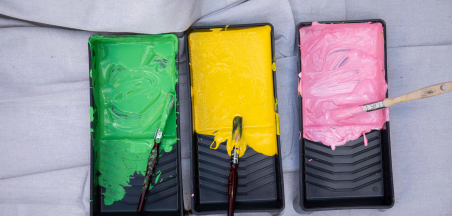
Following discussions with paint suppliers, initial plans involving primer, acrylic paint, non-slip additives, and sealant were revised. Instead, a primer and specialist non-slip paint designed for sports surfaces were used, eliminating the need for additional sealants or additives. Bloomberg Philanthropies’ Asphalt Art Guide proved hugely helpful in the planning stages.
The artwork was installed over ten days, with access to the street limited to pedestrianisation hours (11am–6pm).
What was significant for you about the project that is worth sharing?
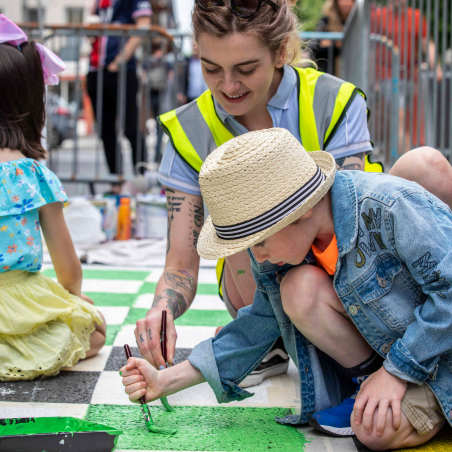
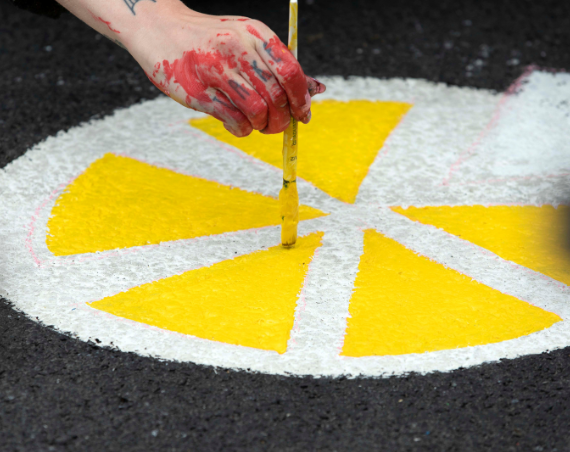
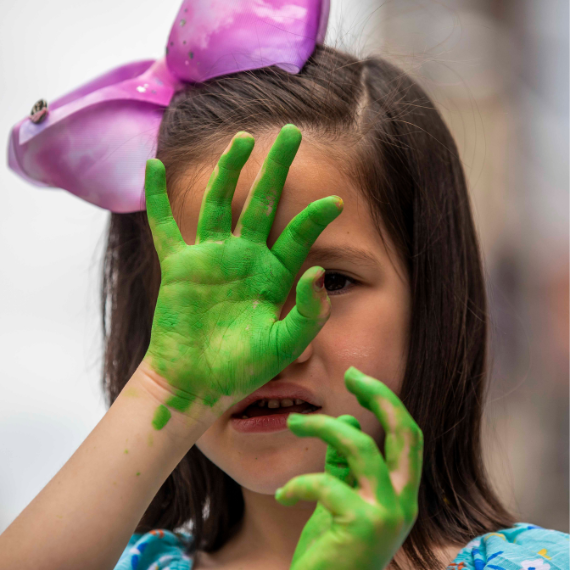
On Cruinniú na nÓg, Saturday 11 June 2021, the young artists took centre stage. Alongside Kathi Burke and a team of technicians, they helped paint the artwork. Passersby stopped to ask questions, offer encouragement, and celebrate their efforts. The Lord Mayor of Cork also visited to meet the participants. Surrounded by family, friends, and support workers, the children experienced a meaningful moment in which their creativity was publicly recognised and celebrated.
Alongside the public artwork, an exhibition at Cork City Library showcased the children’s drawings, stages of Kathi Burke’s design process, and photographs from the workshops.
The temporary artwork was removed in late autumn 2021. A final celebration took place at the Glucksman in December, where families gathered as each participant received a limited-edition framed Open Road print designed by Kathi Burke. As Good Shepherd community support worker Carolyn O’Regan recalled, “The event where the children were honoured at the museum for their contribution to the project, with parents and family members in attendance, was such a crucial moment in the overall project. For parents to see their child recognized in this way was so important, and it’s a memory that will stay with them forever.”
Reflecting on the experience, Kathi Burke said, “What stayed with me was the sheer joy each child brought to the process, and the way our project quietly dissolved the boundaries between very different communities. Seeing a public space in the heart of Cork city transformed by voices that so rarely get to leave that kind of mark was genuinely moving. That is what true collaboration means to me.”
Has anything changed in your work as a result of the project?
The project provided significant learning. Experience gained from concept to realisation informed subsequent initiatives, including the Rainbow Crossing on St Patrick’s Street, installed in July 2022.
The project reaffirmed several core beliefs:
Ambition. The importance of pushing boundaries and creating meaningful, original experiences for communities. Ambitious projects foster engagement, support young people in developing agency and confidence, and enable them to contribute original ideas to the wider cultural sector.
Collaboration. Meaningful work depends on committed collective effort. Collaboration provides a strong platform for young people’s creativity, strengthens projects through shared expertise, and improves outcomes through increased accountability, efficiency, and quality. Since 2022, the Glucksman has developed a range of programmes for young people experiencing homelessness, including the 2025 touring exhibition Art Space.
The title Open Road evokes a sense of freedom and possibility. It reflects the hope shared by all involved—Kathi Burke, the Glucksman team, and community support workers—that these young people’s futures will be shaped by fewer obstacles, and that they will carry forward both the creative skills they developed and the positive memories of the project.
Spotlight
Artist(s):
Kathi Burke is an Irish artist, illustrator, designer and writer. She is also a Scorpio, a pedestrian and an eavesdropper.
Her work spans exhibitions, publishing, public campaigns and brand collaborations. Drawing inspiration from Irish culture, folklore, nature and everyday life, since 2012 she has illustrated over thirty non-fiction children’s books published in Ireland and abroad.
Alongside illustration commissions, her own practice explores collage, embroidery, painting, poetry and printmaking.
Other:
(Curator, agency, etc):
Tadhg Crowley is the Senior Curator – Education + Community at the Glucksman in University College Cork, Ireland. The Glucksman presents a wide-ranging programme of temporary exhibitions accompanied by an extensive education programme to engage visitors of diverse interests and backgrounds.
A graduate of Limerick School of Art and Design, Tadhg’s role at the Glucksman is to help foster an appreciation of the visual arts among the wider public. In 2022, the Glucksman was the recipient of the European Museum Academy Art Museum Award and in their report the judges noted, ‘The Glucksman prioritises its role as a civic institution that enables creative agency among diverse communities. The staff has realized impressive results with their projects, which serve as an inspiration for museums all over the world.’ Tadhg has recently curated projects with communities of interest and communities of place including - Making Waves (2017); Future Forms (2019); and Tales of a City (2020). Tadhg has coordinated the Glucksman’s Creative Agency programme with young asylum seekers since 2015. These engagements at the museum have been realised through a variety of projects including Our Place (2016); Change the Beat (2019); and My Generation (2020). He has curated exhibitions at the museum including Viewpoints (2019); Moving Spaces (2019); and New Light (2020). Tadhg designed the University's first Visual Arts Module for third level students with intellectual disabilities delivered as part of the Certificate in Contemporary Living. In 2019, the module was recognized as one of Europe's Best Practices by the Erasmus + Creative Inclusion in Adult Education.
Artist(s)
Kathi Burke
Tadhg Crowley, Curator
Artforms
School Level
School/
Participant Group
Good Shepherd Cork, Mayfield Youth Cafe
No. Participants
21
Region
Age/Class
6-12 years
Dates
April to August 2021
Weblinks
Leading Agency
The Glucksman, UCC
Other Partners and/or Funders
Cork City Council Arts Service
Key themes/ lines of enquiry
To amplify the voices of children from marginalised communities and celebrate their creativity in the public realm
What stayed with me was the sheer joy each child brought to the process, and the way our project quietly dissolved the boundaries between very different communities.
Kathi Burke, artist