Refine by Region
Refine by Art Form
Refine by School Level
Clann Lir – Children of Lir: In Our Own Words
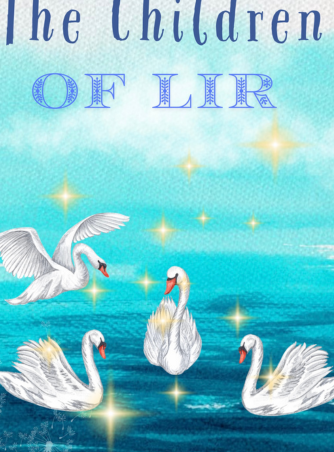
In 2024, the children in Maria Mulligan’s second class from Castlebar Primary School, Co Mayo took part in a project entitled ‘Clann Lir – The Children of Lir: In Our Own Words’.
The project combined music, drama, visual arts, literature and digital design to bring a cherished Irish legend to life in a unique and enchanting way. At the heart of the project were three original songs, crafted by the children themselves, along with visual artist and songwriter Sharon Ní Chuilibín, in response to the Lir saga.
Tell us the story of your project – What was the impetus? What was it about? Who was involved? How did you begin?
Phase 1: Teacher Artist Partnership (TAP) Project
We agreed a focus for our TAP project in our first conversation together – the Irish story of the Children of Lir. This emotive story tells the tale of how four children of King Lir are transformed into swans by their jealous step-mother, condemned to 900 years enduring hardship and suffering with only their human voices to tell of their humanity. On hearing the christian bell they regain their human forms as frail aged people and their souls are released. The story ends in Co. Mayo at the island of Inis Glóra bringing the Irish landscape to life in an emotive way and exploring themes of loss and belonging, grief, resilience, family and togetherness.
The class we worked with included children of diverse ethnic and cultural backgrounds from ten countries. We felt the emotion of the story and how themes of grief, longing and belonging and family so resonate with the reality of migration that impacts the lives of so many children around us today. The story of the Chidlren of Lir is expansive and engaging enough to allow everyone to identify with the four characters in the story – Fionnula, Aodh and twins, Fiacra and Conn.
How were the ideas developed and how did the young people, artist and teacher work together?:
Sharon Ní Chuilibín, Artist, Musician, Songwriter
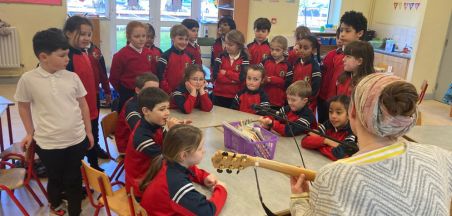
From the start we decided to include both music and visual art activities during my visits to the class. We would begin with the children relaxing to improvised music on low whistle, evoking the atmosphere of the story and I would sing some songs I have composed about nature themes. This provided a comforting atmosphere to nourish imagination and allow a smooth transition from their lessons into a creative frame of mind. Listening to the songs also showed the children how possible it is to create new music and songs themselves. They became familiar with particular songs that they would request each week, such as the Dandelion Song. In the story of the Children of Lir, once the children have been transformed into swans, their human voices are all that remains of their humanity: they are known by their songs.
Composing the new songs came about naturally through conversation with the children. Maria would write words on the board as I asked questions, inviting the children to connect with the Children of Lir characters and imagine what they might have said, or felt at key turning points in the story of the Children of Lir.
Listen to a recording of the composing process in the classroom – recorded by teacher Maria Mulligan:
Our first song, “Bí Sona, Bí Sásta” is the song of the children remembering their mother’s words. “Is bean dubh gránna thú” expresses the anger of the children at being transformed into swans and “900 Years” records the moment of transformation back into human form as elderly people, soon to pass away.
Using recordings of the songs that I had made with the children in class, I combined these with images of their artwork to create videos that the children were able to watch and listen to on YouTube. Maria would play these videos for them to listen to so that they really knew the lyrics. This was helpful when it came to recording the songs with Music Generation Mayo in the second part of the project.
Maria Mulligan, Teacher
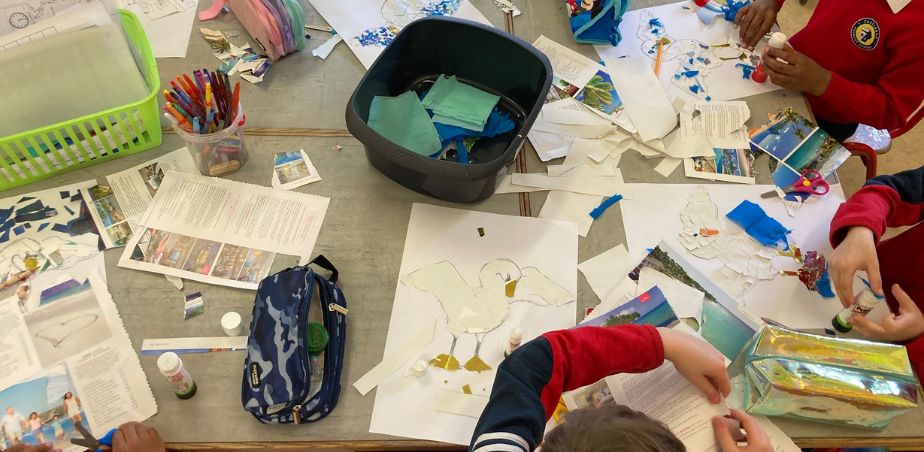
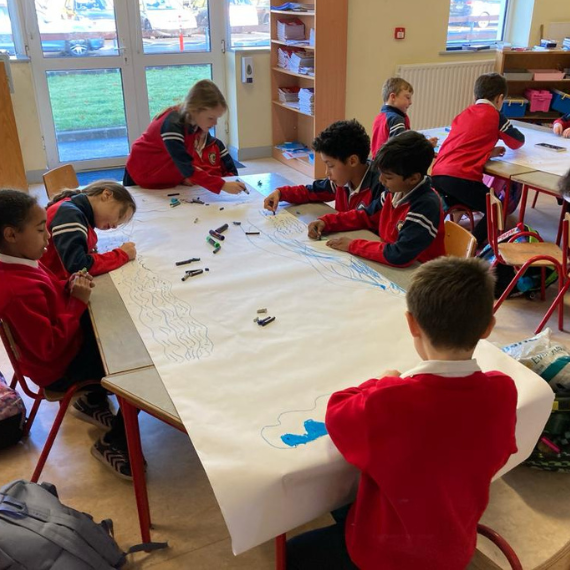
Our sessions together were well planned in advance through online meetings via Zoom and discussions on Whatsapp. Each session included some new materials to inspire the project, for example slide shows of the kinds of clothing that people may have worn in the time of the Children of Lir. We looked at images of places referred to in the story and paintings that the story has inspired. These inputs then informed the children’s creative art activities. Working together in groups, they enjoyed free painting on large sheets of paper using natural materials such as leaves, moss, branches exploring the use of texture and colour to create abstract paintings evoking the feathers of the swans, the stormy seas of Moyle and the waters of Inis Glóra. Later on in the project, templates of Irish native tree leaves were traced onto the paintings and these leaf shapes were then cut out and stuck onto large cardboard swans as collage feathers for four swans.
Phase two – Publishing a book and professional recording of songs
Maria Mulligan
The decision to seek funding to develop the project further and create a book with the children was inspired by the rich outputs achieved in the TAP project. We wanted the children to have a momento as it was a special experience for them. Building on the work we had done with Sharon, we had artwork, three original songs and a unique perspective on the story. I enquired with Mayo County Council and was able to apply for a grant through Creative Communities which allowed us to print copies of the book and record the songs.
As part of the TAP project, I had read and discussed the story with the children so they were able to re-tell it in their own words, from memory. In choosing a version for the book, there had to be room for both pictures and the words so it had to be a reduced-down version of the story. Extracts from the children’s re-telling of the story in their copies were used to form the text of the book.
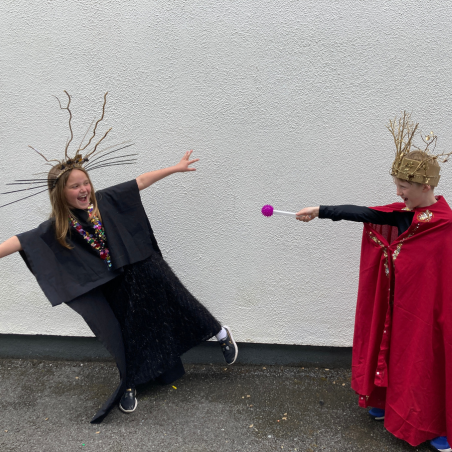
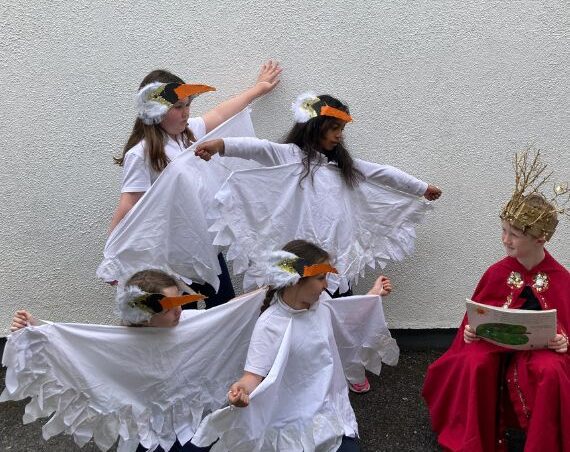
To create images for the book, the children let their creativity flow by constructing accessories for each character from the story using paint, upcycled cardboard, old toys, glue, twigs. flowers and leaves were used to make cloaks, crowns, swan masks and wings. Mostly we used recycled materials; for example, all the cloaks were duvets that they painted. They put glitter and decorations to make them look more ‘royal’
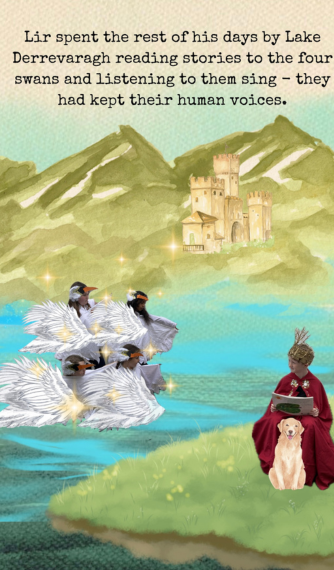
I took photographs of the children wearing their costumes and dramatising the main scenes of the legend through the use of freeze frames. Using the Canva design programme, these photographs were used to create the book with some input from Sharon. The book was then printed by a local printing company.
When all of the hard work was coming to fruition with the recording of the songs and the creation of the book, the book launch was a very important part of the project. It was very important to the children that there was an output that could be shared. We hosted a book and song launch with children’s parents, Councillor Harry Barrett and artist Sharon Ní Chuilibín as special guests.
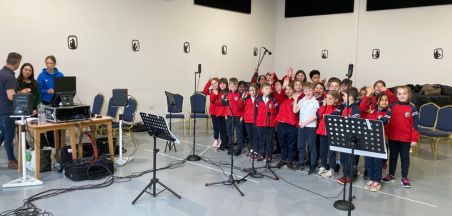
Watch the children perform their songs at the book launch:
Each child received a printed copy of their book that they will have as a special memory forever. A book was also presented to each class of Castlebar Primary School inviting our school community to immerse themselves in the emotional journey crafted by our young storytellers. The book is also available online on Book Creator with links to the videos and songs.
When the book was created the children were able to say, “Wow! This is really amazing what we have done!”
Like an artist with an art exhibition, I feel that you have to pull it all together and have people view it, to have a celebration and sense of completion. Publishing is really important. If you don’t publish what you’ve done it’s still in draft form, it’s in a messy form. Once you publish, that’s where the pride comes then. I think it is really important.
Sharon Ní Chuilibín
To record the new songs composed with the children, we travelled by bus to Music West in Castlebar where we booked a room for a professional recording session with Philip Cassidy from Music Generation Mayo. Volunteer transition year students, Áine Fitzgerald and Juliette Malloy from Davitt College in Castlebar also came along to support the process. In the weeks leading up to the recording of the songs, we rehearsed the songs together via Zoom and at the school. With Maria’s assistance holding the words and encouraging the children, they were able to sing and perform all three songs. This was a great achievement for the children as they had to stand during the recording process and really pay attention, this required a lot of energy and patience. There was great excitement to see the microphones and recording equipment set up for them in the space of Music West, it was a special day out.
What was your personal experience of the project in terms of successes and challenges?
Maria Mulligan
In working with the “Children of Lir” in such an imaginative and engaging way, I noticed that the children really felt a connection to the characters in the story much more than if they had just read the stories. They explored the characters through art and they had acted and dramatised the characters. Children were invited to feel the emotions of the story to create the abstract artwork. Also, the song-writing really made them think about how those characters were feeling. They got a real sense of how the children of Lir felt when their stepmother turned them into swans, and the anger that they felt. In the song that they composed, “900 years“, they really did think about how that would feel – to live for 900 years; they considered it deeply. They were much more connected with the story. I think they will be connected to that story for ever more because they engaged with it on so many different levels artistically.
They had more of a connection with the Irish language and with the fact that, during the time of the Children of Lir, everyone would have spoken Irish. They had more of a positive attitude to the Irish language and speaking Irish after the project. The fact that this was through song helped them to connect with Irish. They knew what the words meant but also the feeling that came through in the music also told them what the words meant. They’ll never forget what those words mean in Irish. That’s very special and doesn’t always happen when you are teaching a class.
Sharon Ní Chuilibín
The children succeeded in really making the story their own, sharing The Children of Lir in their own words through song, word and image. The children had a personal connection with the character that they dramatised in the book – with one child overheard saying “Ah Finn, that’s me, I am Finn”.
Performance and recording the songs required great stamina and concentration of the children. If any mistakes were made during the recording of the song then it was necessary to restart at the very beginning which was both eye opening as well as being frustrating for some children.
With so much material and creativity from the children it was a challenge to represent all of their work and so I edited three short films to accompany the songs, showing the children at work and the process involved in the project.
What was significant for you about the project that is worth sharing?
Maria Mulligan
At the start of the project, the children were probably a bit inhibited and self-conscious. As time went on, they were less inhibited and more confident. They had a sense of achievement, they had contributed to something and made it their own.
Overall, I saw a very positive impact on the children. They definitely worked better as a team within the class and I found that the morale was better. The children were calmer and more able to be in the moment. They were so proud of what they achieved. The project also contributed to children’s enjoyment of school and their self esteem.
Sharon Ní Chuilibín
The class group that participated in this project included children from 10 nationalities and diverse social backgrounds. For some of the children, English was not their first language, for others, they may not have had the opportunity to collaborate creatively as part of a large group before.
A key value of the project is that everyone’s voice has been heard. The children contributed their thoughts and words to create the songs for the project as well as joining together to sing and record the songs as a group.
In creating the final book of the story in their own words, the children had the opportunity to pose as the characters of the story and truly make it their own. This experience will certainly stay with them all through their lives as a positive and inspiring reminder of the power of creativity and of working together.
As the project culminated in a published book of the The Children of Lir, the children were able to perform a concert of the songs and read the story for their families as a special school occasion. This created strong links between home and school and there was a great sense of celebration and achievement on the day. Teacher and Councillor Harry Barrett commented that the project was one of the best that he had seen in forty years of teaching practice.
In a time when there may appear to be division and concern about the arrival of many different cultures in our towns and villages, this project shows how the old tales of Ireland can bring people together through heart felt themes that we all share. The creativity of the children as they worked together on the project is an inspiration to others for what can be achieved when we work for a shared purpose.
Has anything changed in your work as a result of the project?
Sharon Ní Chuilibín
As an artist, I am more aware of the many ways that a project can have a variety of outcomes and how rewarding it is to compose songs with children. I also pay more attention to documentation, as the process is as important as any outcome. It has been valuable to record and acknowledge the children’s own enjoyment and personal experiences throughout our time together.
I have learned that it really makes all the difference when a teacher is invested and committed, bringing their own creative ideas and thought processes to the making of a collaborative project. In some projects I have, on some occasions, felt more like a tolerated visitor. This highlights the importance of developing an atmosphere of collaboration and mutual respect and to highlight the necessity for a teacher to be ‘on board’ and engaged in the process rather than stepping back and handing over. It is important for teachers to recognise that while they know their children and their community, in most cases, a visiting artist does not. It is an asset when there is an openness to creative process, an emphasis on preliminary groundwork and creative exploration.
Maria Mulligan
I feel that I will be able to take the aspects that worked well from the project and bring them into my own teaching. For example, the children really enjoyed engaging in abstract art so I look forward to doing this again. Group collage was also very mindful and enjoyable for the children. Working with a songwriter as talented as Sharon and creating a bilingual song is something that I would love to do again also. Creating a song about a story really helped the children to deeply consider and connect with the characters from the story and I would like to use this in my work in the future.
Watch the children perform their songs inspired by Children of Lir – “Bi Sona”, “Bean Dubh Ghránna” and “900 years’
Spotlight
Artist(s):
Sharon Ní Chuilibín has a BA in Fine art and Art History from the National College of Art and Design (NCAD), an MA in Ethnomusicology (UCC). From 2012-2014 Sharon lived in Cork Dhuibhne, the west Kerry Gaeltacht, while completing a diploma in Irish. Apart from an arts practice, she has worked in publishing & education. An awareness of the foundations of health inform her creative work. She is also a trauma-informed teacher of yoga and meditation and offer services for health and wellbeing including workshops, online courses and retreats. She has also completed trainings in Digital Addiction and Grief literacy.
In creative projects Sharon has engaged with themes of heritage, landscape, folklore and the Irish language. She has developed work in painting, collage, drawing, photography, film and installation. Sharon also composes and performs original songs and music in Irish and English.
Other projects in schools have included composing original songs with the younger classes of Tavneena Primary School, Charlestown, Co. Mayo and more recently a project exploring the locally forgotten Irish folklore collector and writer in Irish Seamus Mag Uidhir.
Previous exhibitions include “Teacht i dTír”, at Áras Inis Gluaire and group show “Scéal Mhapáil | Mapping Stories” & a performance, “Tar Liom”, at the Linenhall in March 2025. Another project is “Cartlann Beo Oileán Thoraigh” | Tory island Living Archive, funded by Creative Ireland.
Teacher(s):
Maria Mulligan is a Primary School teacher at Castlebar Primary School in Co Mayo with a deep interest and passion for the arts. Taking part in the Teacher Artist Partnership (TAP) project allowed her to meet and work with a very talented artist. Maria believes that it is important for children to engage with and enjoy the creative arts and is proud to live in a country where this is supported wholeheartedly by government through initiatives such as TAP, BLAST and Creative Communities. It is a very special experience for children to work with artists, who show such passion and expertise in their fields and as a teacher this is something that Maria would like to facilitate again in the future.
Maria was involved with various TAP projects as well as a project entitled “A Splash of Blue” in conjunction with Kids’ Own Publishing Partnership and Mayo County Council - Arts Service.
Maria is also passionate about sustainability and climate action and was involved in a global Climate Action Project in 2021.

Artist(s)
Sharon Ní Chuilibín
Teacher(s)
Maria Mulligan
Artforms
School Level
School/
Participant Group
Castlebar Primary School
No. Participants
26
Region
Age/Class
8-9 years
Dates
October 2023 - June 2024
Weblinks
Leading Agency
Teacher-Artist Partnership (TAP) CPD
Other Partners and/or Funders
Mayo County Council Arts Service, Creative Ireland – Creative Communities
Key themes/ lines of enquiry
Irish Mythology, History, Drama, Song writing, Musical Composition, Design, Performance.
Curriculum Strands
Art, Irish, English, Music, Geography, History, Drama.
Bí Sona, Bí Sásta, Bí Láidir, Bí Le Chéile
Song by children from Castlebar Primary School